


Lei Zhang’s team reveals how peripheral stem-like CD4⁺ T cell differentiation shapes antitumor immunity in colorectal cancer
Source:Yu Zhang
2026-11-25
Colorectal cancer (CRC) is one of the most common malignancies worldwide and remains a leading cause of cancer-related mortality. In recent years, immune checkpoint blockade (ICB), particularly therapies targeting programmed cell death protein 1 (PD-1), has provided durable clinical benefits for a subset of patients. However, its efficacy in CRC varies substantially across molecular subtypes. Patients with deficient mismatch repair or microsatellite instability-high (dMMR/MSI-H) tumors are generally more responsive to immunotherapy, whereas the majority of patients with proficient mismatch repair or microsatellite-stable (pMMR/MSS) tumors exhibit limited responses. Improving immunotherapy outcomes in pMMR/MSS CRC therefore remains a major challenge.
Previous studies of cancer immunotherapy have primarily focused on the immunosuppressive tumor microenvironment and its regulation. However, the activation, differentiation, and recruitment of peripheral T cells to tumor tissues may also play important roles in determining therapeutic responses. A previous study published in Nature identified CXCL13⁺BHLHE40⁺ Th1-like cells in CRC, showing that these cells are preferentially enriched in MSI tumors and may be associated with favorable responses to ICB [1]. Nevertheless, their spatial organization and antitumor functions within tumors, their relationship to peripheral CD4⁺ T cell differentiation, and the potential to improve local antitumor immunity by targeting peripheral CD4⁺ T cells have remained incompletely understood.
On November 12, 2026, Lei Zhang’s team at Shenzhen Bay Laboratory published a research article entitled “Differentiation of stem-like CD4⁺ T cells modulates early effector responses in colorectal cancer” in Science. Using spatial imaging approaches, the study revealed distinct spatial immune architectures in dMMR/MSI-H and pMMR/MSS CRC. It identified CXCL13⁺CD4⁺ Th1-like cell-associated spatial immune structures in dMMR/MSI-H tumors that were associated with responses to immunotherapy. The researchers further characterized the differentiation trajectory of peripheral stem-like CD4⁺ T cells and their contribution to antitumor immunity. By therapeutically modulating peripheral CD4⁺ T cell differentiation through combined OX40 agonism and PD-1 blockade, the team induced immune features in pMMR tumors that resembled those observed in dMMR/MSI-H tumors, accompanied by enhanced antitumor immune responses. These findings provide new insights into therapeutic strategies that target peripheral immunity to reshape the local tumor microenvironment. An accompanying Science Perspective entitled “Tuning the immune ecosystem to treat cancer” further discussed the significance of this study.
Key findings: Defining the spatial interactions and peripheral differentiation dynamics of CD4⁺ T cells
By integrating imaging mass cytometry (IMC), single-cell transcriptomic profiling, T cell receptor (TCR) repertoire analysis, and a series of in vitro and in vivo functional experiments, the study systematically investigated the roles of CD4⁺ T cells in CRC antitumor immunity, from their spatial organization and differentiation relationships to therapeutic modulation and immune cell cooperation.
1. Characterizing the spatial immune microenvironment and identifying CD4⁺ T cell interactions associated with immunotherapy response
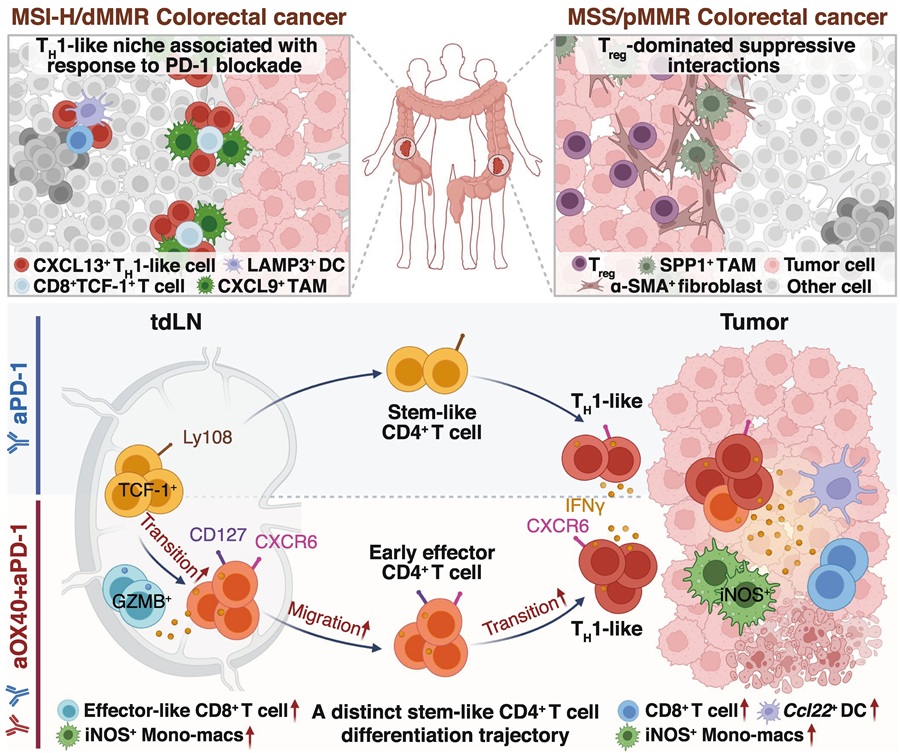
Using IMC, the team performed high-dimensional spatial immune profiling of 295 CRC tissue images and identified distinct spatial immune architectures in dMMR/MSI-H and pMMR/MSS tumors. pMMR/MSS tumors were characterized primarily by Treg-associated immunosuppressive cellular interactions and the spatial colocalization of SPP1⁺ tumor-associated macrophages with fibroblasts. In contrast, dMMR/MSI-H tumors were enriched for spatial immune structures characterized by CXCL13⁺CD4⁺ Th1-like cells, including immune triads composed of CXCL13⁺CD4⁺ T cells, LAMP3⁺ dendritic cells (DCs), and CD8⁺ T cells. In addition, CXCL13⁺ Th1-like CD4⁺ T cells were spatially associated with CXCL9⁺ macrophages and TCF-1⁺CD8⁺ T cells, forming distinct cellular neighborhoods (CNs). This spatial structure showed a higher distribution in patients who responded to PD-1 blockade.
Together, these findings reveal distinct spatial immune organizations across CRC subtypes and suggest that multicellular spatial interactions centered on CXCL13⁺CD4⁺ Th1-like cells are associated with effective antitumor immune responses.
2. Identifying peripheral stem-like CD4⁺ T cells as potential progenitors of intratumoral Th1-like cells
To investigate the developmental origin of intratumoral CXCL13⁺ Th1-like CD4⁺ T cells, the researchers performed single-cell transcriptomic and TCR repertoire analyses of tumor tissues, tumor-draining lymph nodes (tdLNs), and peripheral blood from patients with dMMR/MSI-H CRC receiving PD-1 blockade. They identified substantial TCR sharing between intratumoral Th1-like CD4⁺ T cells and stem-like CD4⁺ T cells in tdLNs, which were characterized by high expression of TCF7 and CCR7. Moreover, compared with pretreatment tumors, stem-like CD4⁺ T cell clonotypes in PD-1 blockade-treated tumors showed more frequent TCR sharing with Th1-like cells, while Th1-like cells exhibited enhanced clonal expansion in posttreatment tumors from patients with a partial response (PR).
These findings suggest that peripheral stem-like CD4⁺ T cells may serve as important progenitors of intratumoral Th1-like cells, highlighting the potential role of peripheral CD4⁺ T cell differentiation in shaping antitumor immune responses to PD-1 blockade.
3. Combining OX40 agonism with PD-1 blockade promotes early effector differentiation of peripheral CD4⁺ T cells
Building on these findings, the team investigated whether therapeutic modulation of peripheral CD4⁺ T cell differentiation could enhance antitumor immunity in pMMR CRC.
In a pMMR mouse CRC model, PD-1 blockade treatment promoted the differentiation of peripheral stem-like CD4⁺ T cells into intratumoral Th1-like CD4⁺ T cells but produced limited antitumor efficacy. In contrast, combination therapy with an OX40 agonist and PD-1 blockade significantly reduced tumor growth. This combination induced an expansion of stem-like CD4⁺ T cells in tdLNs and promoted their differentiation into IL-7R⁺ early effector CD4⁺ T cells. These early effector cells exhibited enhanced migration potential from tdLNs to tumors, where they further differentiated into intratumoral Th1-like CD4⁺ T cells. In addition, combination therapy reduced the clonal expansion of Treg cells at later time points.
These findings suggest that OX40 agonism combined with PD-1 blockade redirects the differentiation trajectory of peripheral stem-like CD4⁺ T cells toward an early effector intermediate state, facilitating their recruitment into tumors and subsequent differentiation into Th1-like cells. This provides a potential therapeutic strategy for enhancing antitumor immunity and improving immunotherapy responses in pMMR CRC.
4. Uncovering coordinated immune cell responses that enhance local antitumor immunity
Further investigation revealed that the early effector differentiation and tumor recruitment of peripheral CD4⁺ T cells induced by combined OX40 agonism and PD-1 blockade were accompanied by coordinated responses from other immune cell populations. IFN-γ produced predominantly by CD4⁺ T cells promoted the accumulation of Cxcl9⁺Nos2⁺ monocyte-macrophages. Meanwhile, the combination treatment induced the expansion of effector-like CD8⁺ T cells in tdLNs, enhanced their migratory potential to tumors, and promoted their differentiation toward effector and nonterminally exhausted states.
Through in vivo functional perturbation experiments, the researchers further demonstrated the importance of peripheral T cell recruitment, IFN-γ signaling, and CD4⁺ T cells and macrophages in mediating the antitumor effects of the combination treatment. These findings reveal how peripheral T cell amplification and recruitment coordinate with IFN-γ-dependent macrophage remodeling and intratumoral CD8⁺ T cell responses to enhance antitumor immunity.
Scientific significance and therapeutic implications: A new perspective on targeting peripheral immunity in cancer immunotherapy
Starting from the spatial organization of the tumor immune microenvironment, this study identifies CXCL13⁺CD4⁺ Th1-like cell-associated spatial interactions linked to immunotherapy responses in CRC. It further characterizes the differentiation trajectory through which peripheral stem-like CD4⁺ T cells transition through an IL-7R⁺ early effector state before acquiring an intratumoral Th1-like phenotype.
By extending the focus of tumor immune regulation beyond the local tumor microenvironment to peripheral T cell differentiation and recruitment, the study suggests that targeting peripheral T cell responses may help coordinate multiple immune cell populations and enhance local antitumor immunity. These findings advance our understanding of the pivotal role of CD4⁺ T cells in antitumor immunity and provide a new conceptual framework and potential translational direction for developing immunotherapeutic strategies against pMMR/MSS CRC and other treatment-resistant solid tumors.
Lei Zhang, Principal Investigator at Shenzhen Bay Laboratory, is the corresponding author of this study. The co-first authors are Yu Zhang, joint PhD student at Shenzhen Bay Laboratory; Hu Nie, Associate Researcher; Zixuan Dai, joint PhD student; Liying Zhao, physician at Nanfang Hospital, Southern Medical University; and Yihong Wan, joint PhD student at Shenzhen Bay Laboratory.
Article link: https://www.science.org/doi/10.1126/science.ady7788
Previous studies of cancer immunotherapy have primarily focused on the immunosuppressive tumor microenvironment and its regulation. However, the activation, differentiation, and recruitment of peripheral T cells to tumor tissues may also play important roles in determining therapeutic responses. A previous study published in Nature identified CXCL13⁺BHLHE40⁺ Th1-like cells in CRC, showing that these cells are preferentially enriched in MSI tumors and may be associated with favorable responses to ICB [1]. Nevertheless, their spatial organization and antitumor functions within tumors, their relationship to peripheral CD4⁺ T cell differentiation, and the potential to improve local antitumor immunity by targeting peripheral CD4⁺ T cells have remained incompletely understood.
On November 12, 2026, Lei Zhang’s team at Shenzhen Bay Laboratory published a research article entitled “Differentiation of stem-like CD4⁺ T cells modulates early effector responses in colorectal cancer” in Science. Using spatial imaging approaches, the study revealed distinct spatial immune architectures in dMMR/MSI-H and pMMR/MSS CRC. It identified CXCL13⁺CD4⁺ Th1-like cell-associated spatial immune structures in dMMR/MSI-H tumors that were associated with responses to immunotherapy. The researchers further characterized the differentiation trajectory of peripheral stem-like CD4⁺ T cells and their contribution to antitumor immunity. By therapeutically modulating peripheral CD4⁺ T cell differentiation through combined OX40 agonism and PD-1 blockade, the team induced immune features in pMMR tumors that resembled those observed in dMMR/MSI-H tumors, accompanied by enhanced antitumor immune responses. These findings provide new insights into therapeutic strategies that target peripheral immunity to reshape the local tumor microenvironment. An accompanying Science Perspective entitled “Tuning the immune ecosystem to treat cancer” further discussed the significance of this study.
Key findings: Defining the spatial interactions and peripheral differentiation dynamics of CD4⁺ T cells
By integrating imaging mass cytometry (IMC), single-cell transcriptomic profiling, T cell receptor (TCR) repertoire analysis, and a series of in vitro and in vivo functional experiments, the study systematically investigated the roles of CD4⁺ T cells in CRC antitumor immunity, from their spatial organization and differentiation relationships to therapeutic modulation and immune cell cooperation.
1. Characterizing the spatial immune microenvironment and identifying CD4⁺ T cell interactions associated with immunotherapy response
Using IMC, the team performed high-dimensional spatial immune profiling of 295 CRC tissue images and identified distinct spatial immune architectures in dMMR/MSI-H and pMMR/MSS tumors. pMMR/MSS tumors were characterized primarily by Treg-associated immunosuppressive cellular interactions and the spatial colocalization of SPP1⁺ tumor-associated macrophages with fibroblasts. In contrast, dMMR/MSI-H tumors were enriched for spatial immune structures characterized by CXCL13⁺CD4⁺ Th1-like cells, including immune triads composed of CXCL13⁺CD4⁺ T cells, LAMP3⁺ dendritic cells (DCs), and CD8⁺ T cells. In addition, CXCL13⁺ Th1-like CD4⁺ T cells were spatially associated with CXCL9⁺ macrophages and TCF-1⁺CD8⁺ T cells, forming distinct cellular neighborhoods (CNs). This spatial structure showed a higher distribution in patients who responded to PD-1 blockade.
Together, these findings reveal distinct spatial immune organizations across CRC subtypes and suggest that multicellular spatial interactions centered on CXCL13⁺CD4⁺ Th1-like cells are associated with effective antitumor immune responses.
2. Identifying peripheral stem-like CD4⁺ T cells as potential progenitors of intratumoral Th1-like cells
To investigate the developmental origin of intratumoral CXCL13⁺ Th1-like CD4⁺ T cells, the researchers performed single-cell transcriptomic and TCR repertoire analyses of tumor tissues, tumor-draining lymph nodes (tdLNs), and peripheral blood from patients with dMMR/MSI-H CRC receiving PD-1 blockade. They identified substantial TCR sharing between intratumoral Th1-like CD4⁺ T cells and stem-like CD4⁺ T cells in tdLNs, which were characterized by high expression of TCF7 and CCR7. Moreover, compared with pretreatment tumors, stem-like CD4⁺ T cell clonotypes in PD-1 blockade-treated tumors showed more frequent TCR sharing with Th1-like cells, while Th1-like cells exhibited enhanced clonal expansion in posttreatment tumors from patients with a partial response (PR).
These findings suggest that peripheral stem-like CD4⁺ T cells may serve as important progenitors of intratumoral Th1-like cells, highlighting the potential role of peripheral CD4⁺ T cell differentiation in shaping antitumor immune responses to PD-1 blockade.
3. Combining OX40 agonism with PD-1 blockade promotes early effector differentiation of peripheral CD4⁺ T cells
Building on these findings, the team investigated whether therapeutic modulation of peripheral CD4⁺ T cell differentiation could enhance antitumor immunity in pMMR CRC.
In a pMMR mouse CRC model, PD-1 blockade treatment promoted the differentiation of peripheral stem-like CD4⁺ T cells into intratumoral Th1-like CD4⁺ T cells but produced limited antitumor efficacy. In contrast, combination therapy with an OX40 agonist and PD-1 blockade significantly reduced tumor growth. This combination induced an expansion of stem-like CD4⁺ T cells in tdLNs and promoted their differentiation into IL-7R⁺ early effector CD4⁺ T cells. These early effector cells exhibited enhanced migration potential from tdLNs to tumors, where they further differentiated into intratumoral Th1-like CD4⁺ T cells. In addition, combination therapy reduced the clonal expansion of Treg cells at later time points.
These findings suggest that OX40 agonism combined with PD-1 blockade redirects the differentiation trajectory of peripheral stem-like CD4⁺ T cells toward an early effector intermediate state, facilitating their recruitment into tumors and subsequent differentiation into Th1-like cells. This provides a potential therapeutic strategy for enhancing antitumor immunity and improving immunotherapy responses in pMMR CRC.
4. Uncovering coordinated immune cell responses that enhance local antitumor immunity
Further investigation revealed that the early effector differentiation and tumor recruitment of peripheral CD4⁺ T cells induced by combined OX40 agonism and PD-1 blockade were accompanied by coordinated responses from other immune cell populations. IFN-γ produced predominantly by CD4⁺ T cells promoted the accumulation of Cxcl9⁺Nos2⁺ monocyte-macrophages. Meanwhile, the combination treatment induced the expansion of effector-like CD8⁺ T cells in tdLNs, enhanced their migratory potential to tumors, and promoted their differentiation toward effector and nonterminally exhausted states.
Through in vivo functional perturbation experiments, the researchers further demonstrated the importance of peripheral T cell recruitment, IFN-γ signaling, and CD4⁺ T cells and macrophages in mediating the antitumor effects of the combination treatment. These findings reveal how peripheral T cell amplification and recruitment coordinate with IFN-γ-dependent macrophage remodeling and intratumoral CD8⁺ T cell responses to enhance antitumor immunity.
Scientific significance and therapeutic implications: A new perspective on targeting peripheral immunity in cancer immunotherapy
Starting from the spatial organization of the tumor immune microenvironment, this study identifies CXCL13⁺CD4⁺ Th1-like cell-associated spatial interactions linked to immunotherapy responses in CRC. It further characterizes the differentiation trajectory through which peripheral stem-like CD4⁺ T cells transition through an IL-7R⁺ early effector state before acquiring an intratumoral Th1-like phenotype.
By extending the focus of tumor immune regulation beyond the local tumor microenvironment to peripheral T cell differentiation and recruitment, the study suggests that targeting peripheral T cell responses may help coordinate multiple immune cell populations and enhance local antitumor immunity. These findings advance our understanding of the pivotal role of CD4⁺ T cells in antitumor immunity and provide a new conceptual framework and potential translational direction for developing immunotherapeutic strategies against pMMR/MSS CRC and other treatment-resistant solid tumors.
Lei Zhang, Principal Investigator at Shenzhen Bay Laboratory, is the corresponding author of this study. The co-first authors are Yu Zhang, joint PhD student at Shenzhen Bay Laboratory; Hu Nie, Associate Researcher; Zixuan Dai, joint PhD student; Liying Zhao, physician at Nanfang Hospital, Southern Medical University; and Yihong Wan, joint PhD student at Shenzhen Bay Laboratory.
Article link: https://www.science.org/doi/10.1126/science.ady7788
