


Prof. Zhiwei Huang’s Team Uncovers a Novel Mechanism of Antigen-Independent γδ T Cell Activation Mediated by BTNL3–BTNL8 Tetramers
Source:Zhiwei Huang
2026-11-24
On August 3, 2026, the research team led by Professor Zhiwei Huang from the School of Life Science and Medicine at Harbin Institute of Technology published a research article entitled “Butyrophilin-like 3 and 8 tetramers clamp Vγ4Vδ1 T cell receptors for antigen-independent activation” in the journal Immunity. The study reveals that the BTNL3–BTNL8 complex assembles into a clamp-like tetramer in an antigen-independent manner, promoting Vγ4Vδ1 T cell receptor (TCR) dimerization and downstream signaling activation. These findings provide new structural and mechanistic insights into γδ T cell activation and intestinal immune homeostasis.
T cells are essential components of the adaptive immune system. In addition to conventional αβ T cells, γδ T cells represent a distinct T cell subset with unique immune functions. They can rapidly sense changes in tissue conditions and play important roles in mucosal immunity, tissue repair, and host defense against pathogens. Intestinal epithelial cells express a family of butyrophilin-like (BTNL) molecules, among which BTNL3 and BTNL8 are key regulators of the development and maintenance of intestinal Vγ4⁺ γδ T cells. However, how BTNL3 and BTNL8 recognize the Vγ4Vδ1 TCR and convert extracellular recognition into intracellular signaling, and whether this unique activation process requires exogenous antigen involvement, remain important unanswered questions.
Using cryo-electron microscopy, the research team resolved the structure of the BTNL3–BTNL8 complex bound to the Vγ4Vδ1 TCR. The structure revealed that BTNL3 and BTNL8 form a stable heterodimer through interactions involving their extracellular Ig domains, transmembrane regions, and intracellular B30.2 domains. Two BTNL3–BTNL8 heterodimers further assemble into a tetramer through interactions between their intracellular B30.2 domains, forming a distinctive clamp-like structure that engages two Vγ4Vδ1 TCRs from opposite sides and results in a hexameric complex with a 2:2:2 stoichiometry. Notably, no density corresponding to bound small-molecule ligands was detected within the B30.2 domains of BTNL3–BTNL8, indicating that tetramer assembly does not require exogenous small-molecule ligands. This mechanism differs from the previously described BTN2A1–BTN3A1-mediated activation of γδ T cells, which requires phosphoantigen binding to the B30.2 domain of BTN3A1 to promote complex assembly. Further structural analysis revealed that recognition of the Vγ4 TCR is primarily mediated by the IgV domain of BTNL3. Arginine residues at positions 97 and 101 of the Vγ4 chain are critical for this interaction, whereas other Vγ subtypes, including Vγ3, Vγ5, Vγ8, and Vγ9, possess residues with different sizes or electrostatic properties at the corresponding positions. These findings reveal the molecular basis for the selective recognition of the Vγ4 chain by BTNL3.
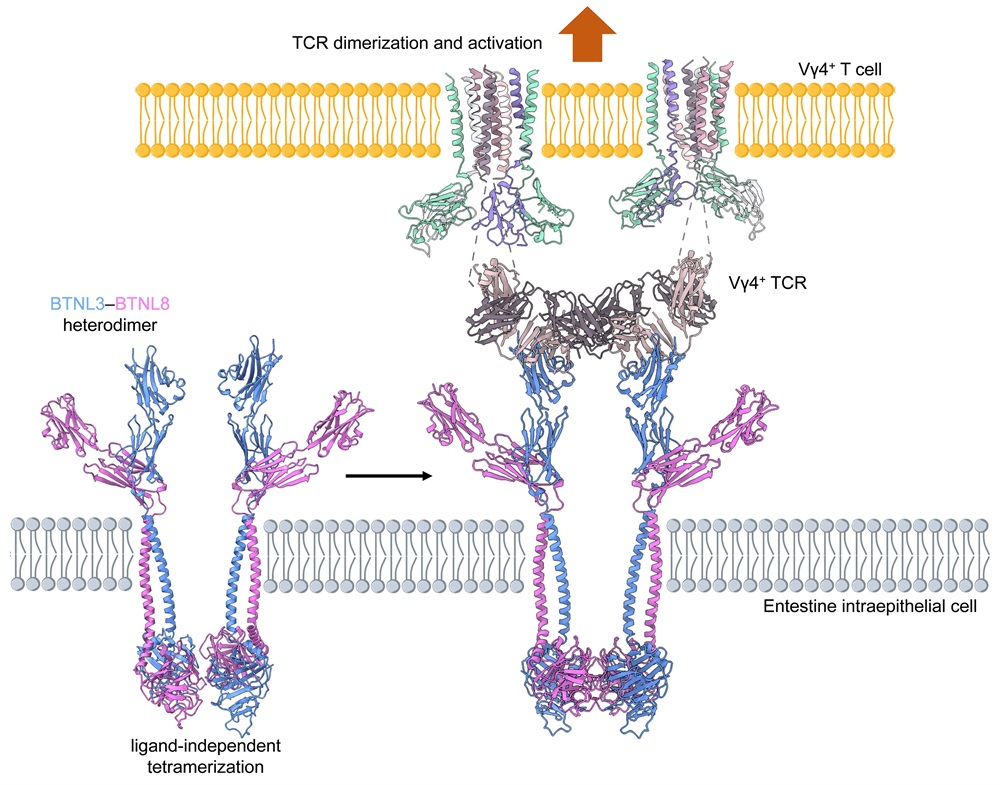
The BTNL3–BTNL8 tetramer further promotes the formation of a head-to-head dimer between two Vγ4Vδ1 TCR molecules, with interactions between their CDR loops contributing to the stabilization of the dimeric conformation. Functional analyses further demonstrated that BTNL3–BTNL8 induces substantial TCR clustering on the cell surface and that TCR dimerization enhances downstream signaling activation. To investigate whether this dimerization mode is conserved across different TCRs, the research team analyzed TCR variants with different CDR3 sequences and different Vδ chain compositions. Cryo-electron microscopy two-dimensional classification revealed that these distinct TCRs could bind BTNL3–BTNL8 in highly similar dimeric conformations, suggesting that this activation mode exhibits structural adaptability and does not strictly depend on specific CDR3 sequences or Vδ chain subtypes. These findings indicate that BTNL3–BTNL8-mediated recognition and organization of TCRs play important roles in this dimerization process, whereas local interactions at the TCR–TCR interface may not be the primary determinants of this activation mode.
In addition, Vγ4Vδ1 TCRs can also be activated by recognizing lipid antigens presented by CD1 family molecules, such as CD1d and CD1a. Structural comparisons revealed substantial spatial overlap between the TCR dimer configuration induced by BTNL3–BTNL8 and the binding mode of TCRs to CD1d/CD1a. These findings suggest that BTNL3–BTNL8-mediated TCR dimerization may sterically preclude simultaneous engagement of Vγ4Vδ1 TCRs with CD1 molecules, providing further insights into the structural relationship between antigen-independent and antigen-dependent γδ T cell activation.
In summary, this study elucidates the structural and molecular mechanisms underlying BTNL3–BTNL8-mediated antigen-independent activation of Vγ4Vδ1 TCRs. BTNL3–BTNL8 assembles into a clamp-like tetramer, selectively recognizes the Vγ4 chain via the IgV domain of BTNL3, and promotes TCR dimerization and downstream signaling activation. This activation mode does not strictly depend on specific CDR3 sequences or Vδ chain subtypes. The findings provide important mechanistic insights into BTNL-mediated γδ T cell recognition and activation, as well as the regulation of intestinal immune homeostasis, and provide a basis for further exploring novel immunomodulatory strategies targeting γδ T cells.
Professor Zhiwei Huang is the corresponding author of this study. De Dong, Huiling Li, and Yuwei Zhu are co-first authors. Zebin Lu, Junliang Zhu, and Xinyu Tian also contributed to this work. This study was supported by the New Cornerstone Investigator Program.
Article link: https://www.cell.com/immunity/abstract/S1074-7613(26)00280-3
T cells are essential components of the adaptive immune system. In addition to conventional αβ T cells, γδ T cells represent a distinct T cell subset with unique immune functions. They can rapidly sense changes in tissue conditions and play important roles in mucosal immunity, tissue repair, and host defense against pathogens. Intestinal epithelial cells express a family of butyrophilin-like (BTNL) molecules, among which BTNL3 and BTNL8 are key regulators of the development and maintenance of intestinal Vγ4⁺ γδ T cells. However, how BTNL3 and BTNL8 recognize the Vγ4Vδ1 TCR and convert extracellular recognition into intracellular signaling, and whether this unique activation process requires exogenous antigen involvement, remain important unanswered questions.
Using cryo-electron microscopy, the research team resolved the structure of the BTNL3–BTNL8 complex bound to the Vγ4Vδ1 TCR. The structure revealed that BTNL3 and BTNL8 form a stable heterodimer through interactions involving their extracellular Ig domains, transmembrane regions, and intracellular B30.2 domains. Two BTNL3–BTNL8 heterodimers further assemble into a tetramer through interactions between their intracellular B30.2 domains, forming a distinctive clamp-like structure that engages two Vγ4Vδ1 TCRs from opposite sides and results in a hexameric complex with a 2:2:2 stoichiometry. Notably, no density corresponding to bound small-molecule ligands was detected within the B30.2 domains of BTNL3–BTNL8, indicating that tetramer assembly does not require exogenous small-molecule ligands. This mechanism differs from the previously described BTN2A1–BTN3A1-mediated activation of γδ T cells, which requires phosphoantigen binding to the B30.2 domain of BTN3A1 to promote complex assembly. Further structural analysis revealed that recognition of the Vγ4 TCR is primarily mediated by the IgV domain of BTNL3. Arginine residues at positions 97 and 101 of the Vγ4 chain are critical for this interaction, whereas other Vγ subtypes, including Vγ3, Vγ5, Vγ8, and Vγ9, possess residues with different sizes or electrostatic properties at the corresponding positions. These findings reveal the molecular basis for the selective recognition of the Vγ4 chain by BTNL3.
The BTNL3–BTNL8 tetramer further promotes the formation of a head-to-head dimer between two Vγ4Vδ1 TCR molecules, with interactions between their CDR loops contributing to the stabilization of the dimeric conformation. Functional analyses further demonstrated that BTNL3–BTNL8 induces substantial TCR clustering on the cell surface and that TCR dimerization enhances downstream signaling activation. To investigate whether this dimerization mode is conserved across different TCRs, the research team analyzed TCR variants with different CDR3 sequences and different Vδ chain compositions. Cryo-electron microscopy two-dimensional classification revealed that these distinct TCRs could bind BTNL3–BTNL8 in highly similar dimeric conformations, suggesting that this activation mode exhibits structural adaptability and does not strictly depend on specific CDR3 sequences or Vδ chain subtypes. These findings indicate that BTNL3–BTNL8-mediated recognition and organization of TCRs play important roles in this dimerization process, whereas local interactions at the TCR–TCR interface may not be the primary determinants of this activation mode.
In addition, Vγ4Vδ1 TCRs can also be activated by recognizing lipid antigens presented by CD1 family molecules, such as CD1d and CD1a. Structural comparisons revealed substantial spatial overlap between the TCR dimer configuration induced by BTNL3–BTNL8 and the binding mode of TCRs to CD1d/CD1a. These findings suggest that BTNL3–BTNL8-mediated TCR dimerization may sterically preclude simultaneous engagement of Vγ4Vδ1 TCRs with CD1 molecules, providing further insights into the structural relationship between antigen-independent and antigen-dependent γδ T cell activation.
In summary, this study elucidates the structural and molecular mechanisms underlying BTNL3–BTNL8-mediated antigen-independent activation of Vγ4Vδ1 TCRs. BTNL3–BTNL8 assembles into a clamp-like tetramer, selectively recognizes the Vγ4 chain via the IgV domain of BTNL3, and promotes TCR dimerization and downstream signaling activation. This activation mode does not strictly depend on specific CDR3 sequences or Vδ chain subtypes. The findings provide important mechanistic insights into BTNL-mediated γδ T cell recognition and activation, as well as the regulation of intestinal immune homeostasis, and provide a basis for further exploring novel immunomodulatory strategies targeting γδ T cells.
Professor Zhiwei Huang is the corresponding author of this study. De Dong, Huiling Li, and Yuwei Zhu are co-first authors. Zebin Lu, Junliang Zhu, and Xinyu Tian also contributed to this work. This study was supported by the New Cornerstone Investigator Program.
Article link: https://www.cell.com/immunity/abstract/S1074-7613(26)00280-3
