


Prof. Jihui Hao’s Team Identifies NET-Mediated Antigen Shielding as a Mechanism of ADC Resistance in Cell
Source:Jihui Hao
2026-11-19
Pancreatic ductal adenocarcinoma (PDAC) remains one of the most lethal malignancies. Antibody–drug conjugates (ADCs) have emerged as a promising therapeutic strategy by coupling antigen-directed recognition with potent cytotoxic payloads. Nevertheless, substantial heterogeneity in therapeutic response persists even among tumors expressing comparable levels of the target antigen. Whether biological sex contributes to this variability has remained poorly understood.
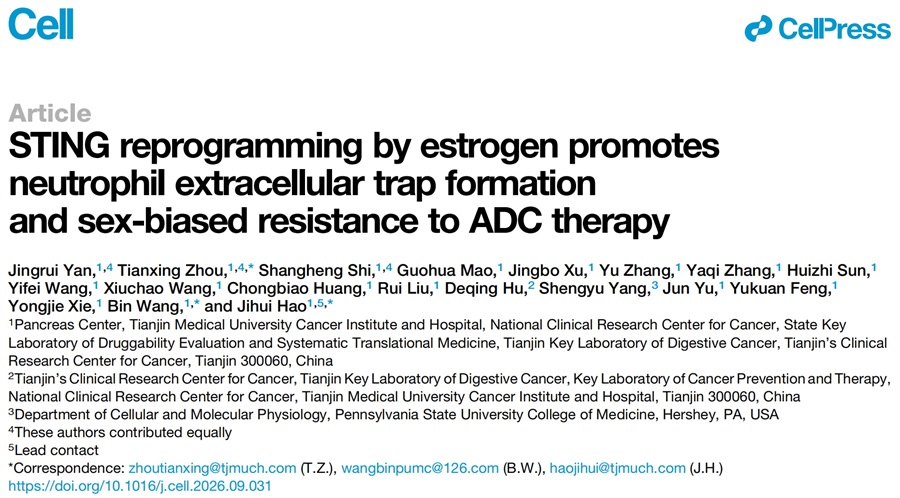
A research team led by Professor Jihui Hao at the Pancreas Center of Tianjin Medical University Cancer Institute and Hospital has published a study in Cell entitled “STING reprogramming by estrogen promotes neutrophil extracellular trap formation and sex-biased resistance to ADC therapy.” Integrating a large-scale patient-derived xenograft (PDX) platform, mechanistic studies and clinical cohort analyses, the investigators identify an estrogen-driven pathway that promotes neutrophil extracellular trap (NET) formation and restricts ADC access to tumor-cell-surface antigens. They define this previously unrecognized resistance mechanism as “functional antigen shielding.”
1. Preclinical screening identifies a host sex associated difference in ADC response
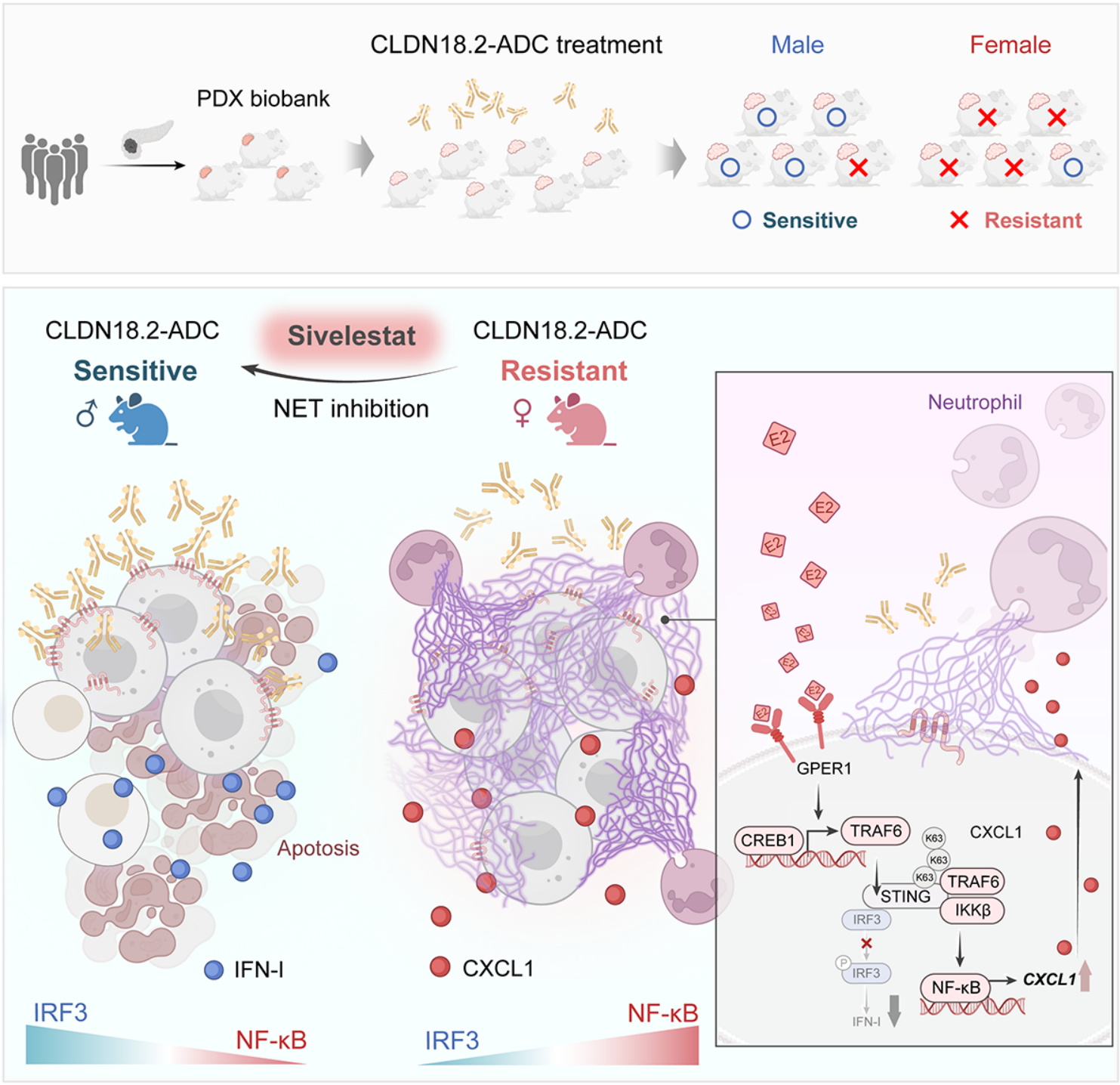
The investigators established a phase II-like preclinical trial comprising 55 CLDN18.2-positive PDAC PDX models. Despite comparable tumor antigen expression, female recipients exhibited substantially reduced responses to CLDN18.2-targeted ADC therapy relative to male recipients. Cross-sex transplantation experiments implicated the host microenvironment rather than the chromosomal sex of the donor tumor. Gonadectomy and hormone-replacement studies further identified estrogen as a key determinant of the observed resistance phenotype.
2. Estrogen reprograms tumor intrinsic STING signaling to recruit neutrophils
Mechanistic analyses revealed that estrogen engages G protein-coupled estrogen receptor 1 (GPER1) in tumor cells and upregulates TNF receptor-associated factor 6 (TRAF6), thereby redirecting STING signaling away from IRF3-dependent type I interferon production toward NF-κB activation. This signaling switch enhances secretion of the neutrophil-attracting chemokine CXCL1 and promotes CXCR2-dependent neutrophil accumulation within the tumor microenvironment. The findings highlight the context-dependent plasticity of innate immune signaling and establish a link between endocrine cues and tumor-associated myeloid remodeling.
3. NET mediated functional antigen shielding restricts antibody access
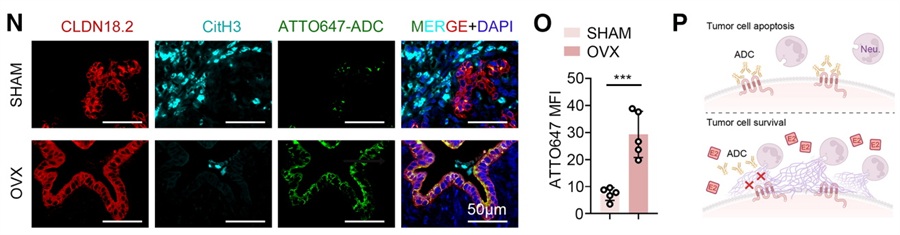
Neutrophils exposed to an estrogen-enriched tumor microenvironment displayed an aging-associated phenotype, elevated reactive oxygen species and increased susceptibility to NETosis. During NET formation, neutrophils release extracellular DNA–protein structures enriched in histones and granule-associated proteins. Scanning electron microscopy visualized extensive NET coverage over tumor-cell surfaces, while immunogold electron microscopy demonstrated reduced accumulation of CLDN18.2-targeted ADCs on NET-coated cells.
Rather than reducing antigen abundance, these dense, charged extracellular structures obscure surface epitopes and may sequester therapeutic antibodies through biochemical interactions. The resulting impairment of antibody–antigen engagement limits ADC binding, internalization and cytotoxicity. The authors designate this process “NET-mediated functional antigen shielding,” distinguishing it from conventional resistance driven by antigen loss or altered payload sensitivity.
4. Targeting NET formation restores therapeutic sensitivity in preclinical models
Genetic disruption of neutrophil NET formation, including neutrophil-lineage Padi4 deletion, alleviated the shielding phenotype and improved ADC activity in experimental models. Pharmacological NET inhibition with sivelestat, a neutrophil elastase inhibitor, likewise restored ADC accessibility and potentiated antitumor responses in female mouse models of pancreatic and gastric cancer. The investigators further observed improved responses to additional antibody-based modalities and ADCs directed against distinct surface antigens, supporting the potential generalizability of the mechanism.
Consistent with these preclinical findings, analyses of clinical cohorts treated with trastuzumab, cetuximab or enfortumab vedotin identified an association between increased intratumoral NET burden and poorer therapeutic response. These observational data provide clinical relevance but do not yet establish that NET-targeted combination treatment improves outcomes in patients.
5. Implications for sex informed precision oncology
The study identifies a mechanistic continuum linking estrogen–GPER1–TRAF6 signaling, STING pathway reprogramming, CXCL1-mediated neutrophil recruitment, NET formation and impaired ADC delivery. Importantly, it suggests that target-antigen expression alone may be insufficient to predict the efficacy of antigen-directed therapies when extracellular immune structures limit antibody accessibility.
These findings provide a rationale for incorporating sex as a prespecified biological variable in future ADC trials and for evaluating NET-related biomarkers and combination strategies. Prospective clinical studies, including formal treatment-by-sex interaction analyses, will be essential to determine the clinical applicability of this mechanism.
Professor Jihui Hao, Associate Research Professor Tianxing Zhou and Assistant Research Professor Bin Wang are the co-corresponding authors. Doctoral student Jingrui Yan, Associate Research Professor Tianxing Zhou and postdoctoral researcher Shangheng Shi contributed equally as co-first authors. The work was supported by funding from the National Natural Science Foundation of China and the Tianjin Natural Science Foundation.
Article link: https://www.cell.com/cell/abstract/S0092-8674(26)01133-5
A research team led by Professor Jihui Hao at the Pancreas Center of Tianjin Medical University Cancer Institute and Hospital has published a study in Cell entitled “STING reprogramming by estrogen promotes neutrophil extracellular trap formation and sex-biased resistance to ADC therapy.” Integrating a large-scale patient-derived xenograft (PDX) platform, mechanistic studies and clinical cohort analyses, the investigators identify an estrogen-driven pathway that promotes neutrophil extracellular trap (NET) formation and restricts ADC access to tumor-cell-surface antigens. They define this previously unrecognized resistance mechanism as “functional antigen shielding.”
1. Preclinical screening identifies a host sex associated difference in ADC response
The investigators established a phase II-like preclinical trial comprising 55 CLDN18.2-positive PDAC PDX models. Despite comparable tumor antigen expression, female recipients exhibited substantially reduced responses to CLDN18.2-targeted ADC therapy relative to male recipients. Cross-sex transplantation experiments implicated the host microenvironment rather than the chromosomal sex of the donor tumor. Gonadectomy and hormone-replacement studies further identified estrogen as a key determinant of the observed resistance phenotype.
2. Estrogen reprograms tumor intrinsic STING signaling to recruit neutrophils
Mechanistic analyses revealed that estrogen engages G protein-coupled estrogen receptor 1 (GPER1) in tumor cells and upregulates TNF receptor-associated factor 6 (TRAF6), thereby redirecting STING signaling away from IRF3-dependent type I interferon production toward NF-κB activation. This signaling switch enhances secretion of the neutrophil-attracting chemokine CXCL1 and promotes CXCR2-dependent neutrophil accumulation within the tumor microenvironment. The findings highlight the context-dependent plasticity of innate immune signaling and establish a link between endocrine cues and tumor-associated myeloid remodeling.
3. NET mediated functional antigen shielding restricts antibody access
Neutrophils exposed to an estrogen-enriched tumor microenvironment displayed an aging-associated phenotype, elevated reactive oxygen species and increased susceptibility to NETosis. During NET formation, neutrophils release extracellular DNA–protein structures enriched in histones and granule-associated proteins. Scanning electron microscopy visualized extensive NET coverage over tumor-cell surfaces, while immunogold electron microscopy demonstrated reduced accumulation of CLDN18.2-targeted ADCs on NET-coated cells.
Rather than reducing antigen abundance, these dense, charged extracellular structures obscure surface epitopes and may sequester therapeutic antibodies through biochemical interactions. The resulting impairment of antibody–antigen engagement limits ADC binding, internalization and cytotoxicity. The authors designate this process “NET-mediated functional antigen shielding,” distinguishing it from conventional resistance driven by antigen loss or altered payload sensitivity.
Fig. Estrogen-driven neutrophil extracellular traps (NETs) mediate functional antigen shielding.
4. Targeting NET formation restores therapeutic sensitivity in preclinical models
Genetic disruption of neutrophil NET formation, including neutrophil-lineage Padi4 deletion, alleviated the shielding phenotype and improved ADC activity in experimental models. Pharmacological NET inhibition with sivelestat, a neutrophil elastase inhibitor, likewise restored ADC accessibility and potentiated antitumor responses in female mouse models of pancreatic and gastric cancer. The investigators further observed improved responses to additional antibody-based modalities and ADCs directed against distinct surface antigens, supporting the potential generalizability of the mechanism.
Consistent with these preclinical findings, analyses of clinical cohorts treated with trastuzumab, cetuximab or enfortumab vedotin identified an association between increased intratumoral NET burden and poorer therapeutic response. These observational data provide clinical relevance but do not yet establish that NET-targeted combination treatment improves outcomes in patients.
5. Implications for sex informed precision oncology
The study identifies a mechanistic continuum linking estrogen–GPER1–TRAF6 signaling, STING pathway reprogramming, CXCL1-mediated neutrophil recruitment, NET formation and impaired ADC delivery. Importantly, it suggests that target-antigen expression alone may be insufficient to predict the efficacy of antigen-directed therapies when extracellular immune structures limit antibody accessibility.
These findings provide a rationale for incorporating sex as a prespecified biological variable in future ADC trials and for evaluating NET-related biomarkers and combination strategies. Prospective clinical studies, including formal treatment-by-sex interaction analyses, will be essential to determine the clinical applicability of this mechanism.
Professor Jihui Hao, Associate Research Professor Tianxing Zhou and Assistant Research Professor Bin Wang are the co-corresponding authors. Doctoral student Jingrui Yan, Associate Research Professor Tianxing Zhou and postdoctoral researcher Shangheng Shi contributed equally as co-first authors. The work was supported by funding from the National Natural Science Foundation of China and the Tianjin Natural Science Foundation.
Article link: https://www.cell.com/cell/abstract/S0092-8674(26)01133-5
