


Jianli He and Jinke Cheng's Team Uncovers the Mechanism by Which VEGF-B Signaling Axis Maintains Intestinal Immune Homeostasis to Resist Obesity
Source:Jianli He
2026-11-17
On November 10, 2026, a collaborative team led by Associate Professor Jianli He from Shanghai Jiao Tong University School of Medicine and Professor Jinke Cheng from the Hainan Academy of Medical Sciences published a paper titled "Growth factor VEGF-B sustains intestinal Tfh cell stemness to restrict Taurinivorans outgrowth and microbiota-driven obesity" in the international academic journal Immunity. This study reveals that the VEGF-B/VEGFR-1 signaling axis maintains intestinal mucosal immune surveillance by suppressing p53-mediated Tfh cell senescence, thereby preventing the overgrowth of conditional pathogens and the depletion of microbial metabolites, conferring resistance to systemic obesity. This work, for the first time, links "intestinal immune senescence" with "microbial metabolite depletion", providing novel targets for immunological intervention in systemic metabolic disorders.
Intestinal T follicular helper (Tfh) cells monitor and regulate the gut microbiota by promoting immunoglobulin A (IgA) secretion. However, under metabolic stress such as obesity, the key molecular signals that sustain intestinal Tfh cell homeostasis and prevent senescence, as well as the mechanisms by which specific microbes drive systemic metabolic disorders after mucosal immune surveillance fails, remain largely unknown.
Building on the team's long-term expertise in "mitochondrial lipid homeostasis and immune cell fate determination," the researchers identified VEGF-B/VEGFR-1 as a key signal for maintaining the "stemness" of intestinal Tfh cells. Mechanistic analysis revealed that loss of this signal triggers p53 hyperactivation, inducing severe senescence in intestinal Tfh cells and leading to a sharp reduction in protective IgA secretion. With the impairment of mucosal immune surveillance, a conditional pathogen named Taurinivorans significantly expands in the gut and competitively depletes taurine, a key host metabolite. The excessive depletion of taurine by the pathogen further suppresses thermogenic signaling in adipose tissue, ultimately inducing obesity.
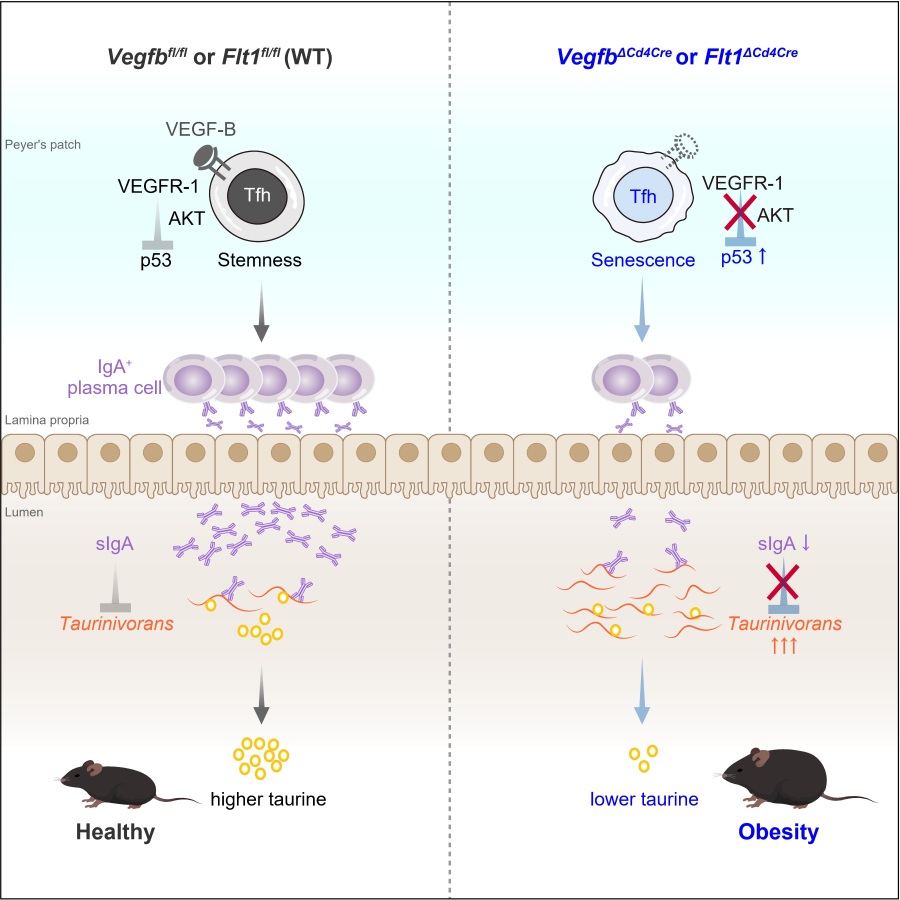
Intervention experiments confirmed the translational potential of this pathway: targeting the VEGF-B/VEGFR-1 pathway effectively reverses Tfh cell senescence, while supplementation with specific sIgA efficiently suppresses pathogen expansion and significantly alleviates the obese phenotype. This discovery not only clarifies the tiered strategies of upstream immune intervention and downstream symptom relief but also provides multi-dimensional potential targets for metabolic diseases.
In summary, this study not only elucidates the molecular mechanism of intestinal Tfh cell senescence but also defines the pathogenic chain of "mucosal immune senescence – microbial dysbiosis – metabolite depletion," offering a novel perspective for understanding the immunological etiology of systemic metabolic abnormalities such as obesity.
Associate Professor Jianli He, Professor Jinke Cheng, Researcher Yong Zuo from Shanghai Jiao Tong University School of Medicine, and Researcher Ningning Liu from Shanghai Jiao Tong University School of Public Health are co-corresponding authors. Jin-An Zhou, Associate Professor Jun Tu, and Associate Chief Physician Jiang Yue are co-first authors.
Article link: https://doi.org/10.1016/j.immuni.2026.10.004
Intestinal T follicular helper (Tfh) cells monitor and regulate the gut microbiota by promoting immunoglobulin A (IgA) secretion. However, under metabolic stress such as obesity, the key molecular signals that sustain intestinal Tfh cell homeostasis and prevent senescence, as well as the mechanisms by which specific microbes drive systemic metabolic disorders after mucosal immune surveillance fails, remain largely unknown.
Building on the team's long-term expertise in "mitochondrial lipid homeostasis and immune cell fate determination," the researchers identified VEGF-B/VEGFR-1 as a key signal for maintaining the "stemness" of intestinal Tfh cells. Mechanistic analysis revealed that loss of this signal triggers p53 hyperactivation, inducing severe senescence in intestinal Tfh cells and leading to a sharp reduction in protective IgA secretion. With the impairment of mucosal immune surveillance, a conditional pathogen named Taurinivorans significantly expands in the gut and competitively depletes taurine, a key host metabolite. The excessive depletion of taurine by the pathogen further suppresses thermogenic signaling in adipose tissue, ultimately inducing obesity.
Intervention experiments confirmed the translational potential of this pathway: targeting the VEGF-B/VEGFR-1 pathway effectively reverses Tfh cell senescence, while supplementation with specific sIgA efficiently suppresses pathogen expansion and significantly alleviates the obese phenotype. This discovery not only clarifies the tiered strategies of upstream immune intervention and downstream symptom relief but also provides multi-dimensional potential targets for metabolic diseases.
In summary, this study not only elucidates the molecular mechanism of intestinal Tfh cell senescence but also defines the pathogenic chain of "mucosal immune senescence – microbial dysbiosis – metabolite depletion," offering a novel perspective for understanding the immunological etiology of systemic metabolic abnormalities such as obesity.
Associate Professor Jianli He, Professor Jinke Cheng, Researcher Yong Zuo from Shanghai Jiao Tong University School of Medicine, and Researcher Ningning Liu from Shanghai Jiao Tong University School of Public Health are co-corresponding authors. Jin-An Zhou, Associate Professor Jun Tu, and Associate Chief Physician Jiang Yue are co-first authors.
Article link: https://doi.org/10.1016/j.immuni.2026.10.004
