


Fudan University Researchers Led by Prof. Jianfeng Chen and Collaborators Publish in Cell: Targeting Peripheral 5-HT2AR Enhances Antitumor Immunity in Colorectal Cancer
Source:Yating Wen
2026-09-11
Colorectal cancer (CRC) is the third leading cause of cancer-related mortality worldwide. In recent years, immune checkpoint inhibitors (ICIs) have emerged as an important therapeutic approach for cancer. However, more than 85% of CRC cases are microsatellite stable (MSS) tumors, which generally show poor responses to ICIs, representing a major challenge in clinical treatment. Meanwhile, an increasing number of clinical studies have reported a high prevalence of depression and anxiety among patients with cancer. These psychological conditions can further increase the burden of cancer and are associated with poorer clinical outcomes. As a result, increasing attention has been directed toward psychological interventions for patients with cancer. Previous studies have shown that psychedelic-assisted therapy can effectively alleviate anxiety in patients with advanced cancer and may improve patient outcomes. However, whether psychedelics themselves possess direct antitumor activity has remained an important unanswered question in biomedical research.
On September 3, 2026, a collaborative team led by Professor Jianfeng Chen from the School of Basic Medical Sciences at Fudan University, together with researchers from the Center for Excellence in Molecular Cell Science, Chinese Academy of Sciences, ShanghaiTech University, Shanghai Changhai Hospital, and other institutions, published a research article entitled “Targeting Peripheral 5-HT2AR Enhances Antitumor Immunity in Colorectal Cancer” in Cell. The study identified serotonin 2A receptor (5-HT2AR) expressed on enteric glial cells (EGCs) as a potential target for activating antitumor immunity. Selective activation of peripheral 5-HT2AR promotes communication between the enteric nervous system and immune cells, thereby enhancing antitumor immune responses. Combination with immune checkpoint blockade further improved the therapeutic efficacy against CRC, providing a new strategy for CRC treatment.
LSD Mediates Antitumor Immunity through 5-HT2AR
Lysergic acid diethylamide (LSD) is a classic agonist of 5-HT2AR. The research team first found in an orthotopic mouse model of CRC that the psychedelic compound LSD significantly inhibited tumor growth through activation of 5-HT2AR. Further studies showed that this effect was associated with the recruitment and activation of tumor-infiltrating cytotoxic CD8+ T cells, which mediated antitumor activity. Moreover, the 5-HT2AR-selective antagonist MDL100907 reversed the antitumor effects of LSD as well as the increased infiltration and activation of CD8+ T cells, indicating that LSD promotes CD8+ T cell-mediated antitumor immunity through 5-HT2AR.
However, LSD readily crosses the blood-brain barrier and activates central 5-HT2AR, resulting in hallucinogenic and other central nervous system effects that limit its further clinical development. Therefore, an important question was whether the peripheral pharmacological activity of LSD could be retained while minimizing its central effects.
Development of the Peripherally Selective 5-HT2AR Agonist IHCH-8110
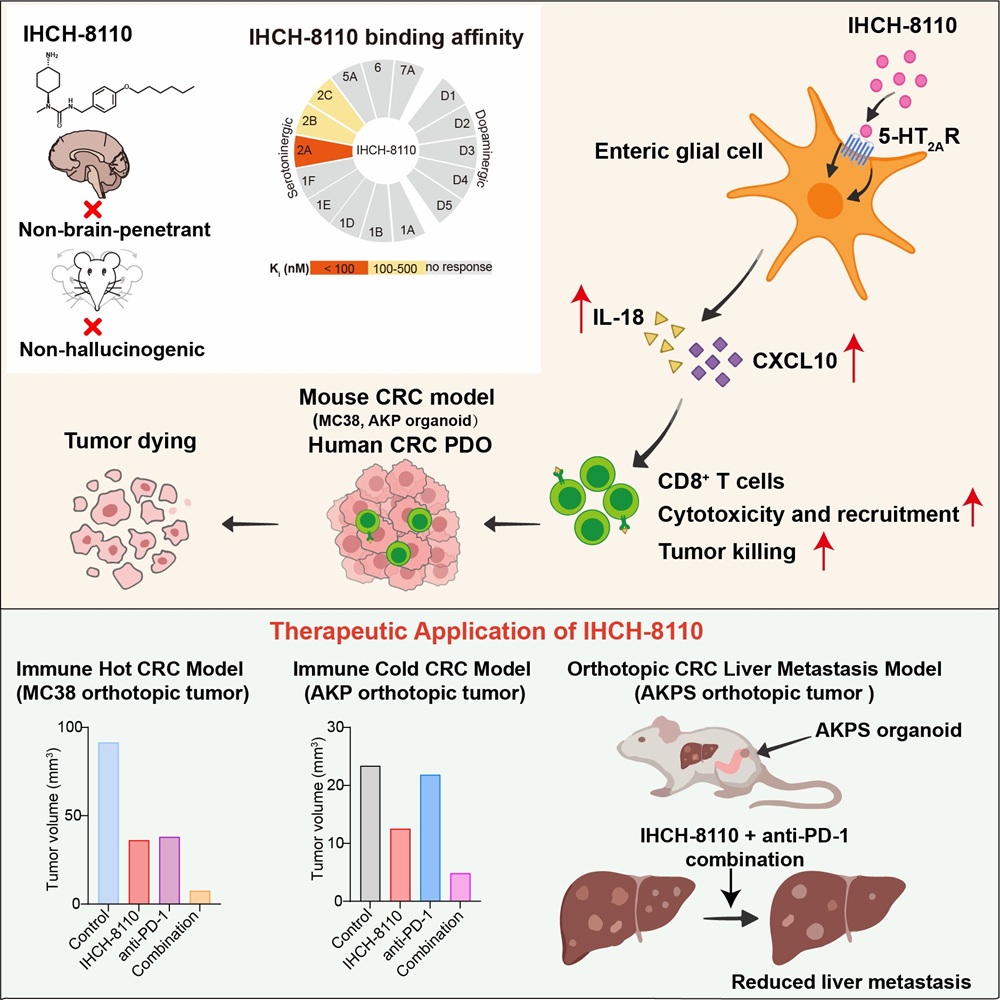
To avoid the hallucinogenic effects associated with activation of central 5-HT2AR, the research team used a structure-guided design strategy to develop IHCH-8110, a 5-HT2AR agonist with low blood-brain barrier permeability. Pharmacological and pharmacokinetic studies showed that IHCH-8110 activates 5-HT2AR while also antagonizing 5-HT2BR, and primarily acts in peripheral tissues without producing typical central hallucinogenic effects. Further safety evaluation demonstrated good tolerability and metabolic stability, supporting IHCH-8110 as a candidate compound for targeting peripheral 5-HT2AR.
IHCH-8110 Activates Antitumor Immunity through Enteric Glial Cells
To identify the key target cells responsible for the antitumor activity of IHCH-8110, they analyzed 5-HT2AR expression across different cell populations in colorectal tissues. 5-HT2AR was found to be highly expressed in EGCs. Genetic studies further showed that selective deletion of 5-HT2AR in EGCs markedly abolished the antitumor effects of IHCH-8110, indicating that EGCs serve as an important cellular hub linking 5-HT2AR signaling to antitumor immunity.
CXCL10 and IL-18 Coordinate CD8+ T Cell Antitumor Responses
Further investigation revealed that activation of EGCs by IHCH-8110 promotes the production of the chemokine CXCL10 and the cytokine IL-18. CXCL10 contributes to the recruitment of CD8+ T cells into tumor tissues, while IL-18 further enhances their cytotoxic function. These findings established a regulatory pathway linking “5-HT2AR–EGC–CXCL10/IL-18–CD8+ T cells.”
Notably, this mechanism was conserved between humans and mice. The researchers isolated human EGCs from CRC patient tissues and confirmed that these cells also express 5-HT2AR. Treatment with IHCH-8110 enhanced the secretion of CXCL10 and IL-18 by human EGCs and promoted CD8+ T cell migration and tumor-killing activity, providing a rationale for further clinical translation of this approach.
Combination with PD-1 Blockade Provides a New Strategy for MSS CRC
To determine whether the novel 5-HT2AR agonist IHCH-8110 could address the limited response of MSS CRC to immune checkpoint blockade, the research team further evaluated the efficacy of IHCH-8110 in combination with a PD-1 antibody in MSS tumor models. Across multiple CRC models, IHCH-8110 inhibited tumor growth, while combination treatment with PD-1 blockade further enhanced antitumor efficacy and showed an additional inhibitory effect on liver metastasis.
These findings suggest that IHCH-8110 promotes antitumor activity by remodeling the tumor immune microenvironment and increasing CD8+ T cell infiltration, potentially creating a more favorable context for PD-1-based immunotherapy. The study therefore provides a new rationale for combination immunotherapy in MSS CRC.
In summary, this study identified an EGC–CD8+ T cell neuroimmune regulatory axis in CRC and established a strategy for enhancing antitumor immunity by targeting 5-HT2AR on EGCs. The development of the peripherally selective 5-HT2AR agonist IHCH-8110 provides a new therapeutic direction for CRC, particularly for MSS CRC, which remains poorly responsive to current immunotherapies.
Professor Jianfeng Chen from the School of Basic Medical Sciences at Fudan University, Researcher Sheng Wang and Researcher Yi Zeng from the Center for Excellence in Molecular Cell Science, Chinese Academy of Sciences, Researcher Jianjun Cheng from the iHuman Institute at ShanghaiTech University, Associate Researcher Shihui Wang from the Institute of Cancer Research at Shanghai Jiao Tong University, and Professor Wei Zhang from Shanghai Changhai Hospital are the co-corresponding authors of the study. Dr. Yating Wen, a postdoctoral researcher at the School of Basic Medical Sciences, Fudan University, is the first author and co-corresponding author. Dr. Lingjie Tang and Dr. Qingfei Ren from the Center for Excellence in Molecular Cell Science, Chinese Academy of Sciences, Assistant Researcher Wenwen Duan from the iHuman Institute at ShanghaiTech University, Dr. Yangyue Ni from Shanghai Pulmonary Hospital, Associate Researcher Shiyang Chen from Shanghai Pudong Hospital, and doctoral student Jun Chen from Shanghai Changhai Hospital are co-first authors. This work was supported by the National Key Research and Development Program of China, the Strategic Priority Research Program of the Chinese Academy of Sciences, the National Natural Science Foundation of China, and related research platforms.
Article link: https://www.cell.com/cell/abstract/S0092-8674(26)00826-3
On September 3, 2026, a collaborative team led by Professor Jianfeng Chen from the School of Basic Medical Sciences at Fudan University, together with researchers from the Center for Excellence in Molecular Cell Science, Chinese Academy of Sciences, ShanghaiTech University, Shanghai Changhai Hospital, and other institutions, published a research article entitled “Targeting Peripheral 5-HT2AR Enhances Antitumor Immunity in Colorectal Cancer” in Cell. The study identified serotonin 2A receptor (5-HT2AR) expressed on enteric glial cells (EGCs) as a potential target for activating antitumor immunity. Selective activation of peripheral 5-HT2AR promotes communication between the enteric nervous system and immune cells, thereby enhancing antitumor immune responses. Combination with immune checkpoint blockade further improved the therapeutic efficacy against CRC, providing a new strategy for CRC treatment.
LSD Mediates Antitumor Immunity through 5-HT2AR
Lysergic acid diethylamide (LSD) is a classic agonist of 5-HT2AR. The research team first found in an orthotopic mouse model of CRC that the psychedelic compound LSD significantly inhibited tumor growth through activation of 5-HT2AR. Further studies showed that this effect was associated with the recruitment and activation of tumor-infiltrating cytotoxic CD8+ T cells, which mediated antitumor activity. Moreover, the 5-HT2AR-selective antagonist MDL100907 reversed the antitumor effects of LSD as well as the increased infiltration and activation of CD8+ T cells, indicating that LSD promotes CD8+ T cell-mediated antitumor immunity through 5-HT2AR.
However, LSD readily crosses the blood-brain barrier and activates central 5-HT2AR, resulting in hallucinogenic and other central nervous system effects that limit its further clinical development. Therefore, an important question was whether the peripheral pharmacological activity of LSD could be retained while minimizing its central effects.
Development of the Peripherally Selective 5-HT2AR Agonist IHCH-8110
To avoid the hallucinogenic effects associated with activation of central 5-HT2AR, the research team used a structure-guided design strategy to develop IHCH-8110, a 5-HT2AR agonist with low blood-brain barrier permeability. Pharmacological and pharmacokinetic studies showed that IHCH-8110 activates 5-HT2AR while also antagonizing 5-HT2BR, and primarily acts in peripheral tissues without producing typical central hallucinogenic effects. Further safety evaluation demonstrated good tolerability and metabolic stability, supporting IHCH-8110 as a candidate compound for targeting peripheral 5-HT2AR.
IHCH-8110 Activates Antitumor Immunity through Enteric Glial Cells
To identify the key target cells responsible for the antitumor activity of IHCH-8110, they analyzed 5-HT2AR expression across different cell populations in colorectal tissues. 5-HT2AR was found to be highly expressed in EGCs. Genetic studies further showed that selective deletion of 5-HT2AR in EGCs markedly abolished the antitumor effects of IHCH-8110, indicating that EGCs serve as an important cellular hub linking 5-HT2AR signaling to antitumor immunity.
CXCL10 and IL-18 Coordinate CD8+ T Cell Antitumor Responses
Further investigation revealed that activation of EGCs by IHCH-8110 promotes the production of the chemokine CXCL10 and the cytokine IL-18. CXCL10 contributes to the recruitment of CD8+ T cells into tumor tissues, while IL-18 further enhances their cytotoxic function. These findings established a regulatory pathway linking “5-HT2AR–EGC–CXCL10/IL-18–CD8+ T cells.”
Notably, this mechanism was conserved between humans and mice. The researchers isolated human EGCs from CRC patient tissues and confirmed that these cells also express 5-HT2AR. Treatment with IHCH-8110 enhanced the secretion of CXCL10 and IL-18 by human EGCs and promoted CD8+ T cell migration and tumor-killing activity, providing a rationale for further clinical translation of this approach.
Combination with PD-1 Blockade Provides a New Strategy for MSS CRC
To determine whether the novel 5-HT2AR agonist IHCH-8110 could address the limited response of MSS CRC to immune checkpoint blockade, the research team further evaluated the efficacy of IHCH-8110 in combination with a PD-1 antibody in MSS tumor models. Across multiple CRC models, IHCH-8110 inhibited tumor growth, while combination treatment with PD-1 blockade further enhanced antitumor efficacy and showed an additional inhibitory effect on liver metastasis.
These findings suggest that IHCH-8110 promotes antitumor activity by remodeling the tumor immune microenvironment and increasing CD8+ T cell infiltration, potentially creating a more favorable context for PD-1-based immunotherapy. The study therefore provides a new rationale for combination immunotherapy in MSS CRC.
In summary, this study identified an EGC–CD8+ T cell neuroimmune regulatory axis in CRC and established a strategy for enhancing antitumor immunity by targeting 5-HT2AR on EGCs. The development of the peripherally selective 5-HT2AR agonist IHCH-8110 provides a new therapeutic direction for CRC, particularly for MSS CRC, which remains poorly responsive to current immunotherapies.
Professor Jianfeng Chen from the School of Basic Medical Sciences at Fudan University, Researcher Sheng Wang and Researcher Yi Zeng from the Center for Excellence in Molecular Cell Science, Chinese Academy of Sciences, Researcher Jianjun Cheng from the iHuman Institute at ShanghaiTech University, Associate Researcher Shihui Wang from the Institute of Cancer Research at Shanghai Jiao Tong University, and Professor Wei Zhang from Shanghai Changhai Hospital are the co-corresponding authors of the study. Dr. Yating Wen, a postdoctoral researcher at the School of Basic Medical Sciences, Fudan University, is the first author and co-corresponding author. Dr. Lingjie Tang and Dr. Qingfei Ren from the Center for Excellence in Molecular Cell Science, Chinese Academy of Sciences, Assistant Researcher Wenwen Duan from the iHuman Institute at ShanghaiTech University, Dr. Yangyue Ni from Shanghai Pulmonary Hospital, Associate Researcher Shiyang Chen from Shanghai Pudong Hospital, and doctoral student Jun Chen from Shanghai Changhai Hospital are co-first authors. This work was supported by the National Key Research and Development Program of China, the Strategic Priority Research Program of the Chinese Academy of Sciences, the National Natural Science Foundation of China, and related research platforms.
Article link: https://www.cell.com/cell/abstract/S0092-8674(26)00826-3
