


Yafeng Zhang and Xiaohui Meng’s Team Identifies BCAT2 as a Driver of Persistent Inflammation in Rheumatoid Arthritis
Source:Yafeng Zhang
2026-09-10
In September 2026, a team led by Yafeng Zhang and Xiaohui Meng at Wuxi Hospital Affiliated to Nanjing University of Chinese Medicine published a study in Nature Immunology, entitled “BCAT2 links branched-chain amino acids metabolism to interferon signaling to sustain macrophage inflammation”. Conducted with Lianbo Xiao of Shanghai University of Traditional Chinese Medicine and Wei Yao of the University of California, the study reveals how BCAT2 sustains macrophage inflammation by altering mitochondrial redox balance and amplifying interferon signaling, highlighting a potential therapeutic target for rheumatoid arthritis (RA).
Macrophages are key drivers of synovial inflammation in RA, but why they remain persistently activated is unclear. To address this question, the team combined patient sample analyses with metabolomics, single-cell transcriptomics, primary-cell experiments, and animal models to investigate how branched-chain amino acid metabolism contributes to chronic inflammation.
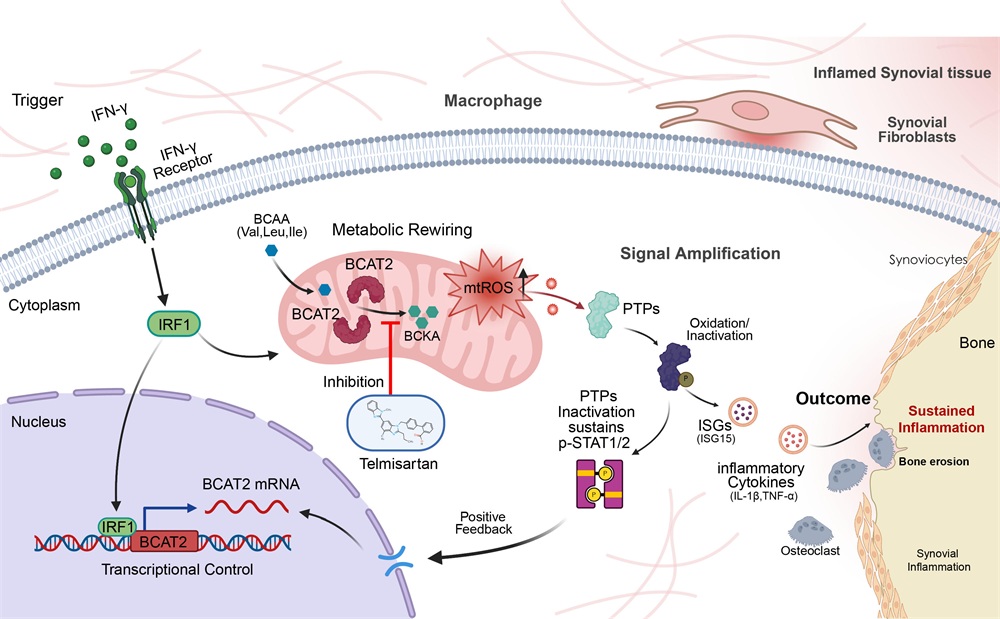
The researchers found altered branched-chain amino acid and metabolite profiles in patients with active RA, alongside elevated BCAT2 expression in synovial macrophages. Mechanistically, interferon-γ induces BCAT2 expression through the transcription factor IRF1. BCAT2-driven metabolic changes then increase mitochondrial reactive oxygen species, inhibit the negative regulator SHP-1, and prolong STAT1 and STAT2 signaling. This process weakens the cellular “brakes” on inflammation, keeping macrophages in a proinflammatory state.
The findings extend the role of branched-chain amino acid metabolism beyond nutrient supply to the control of inflammatory signaling. By linking amino acid metabolism to mitochondrial redox balance and interferon responses, BCAT2 helps explain how inflammation persists in RA. Genetic and pharmacological studies further support its potential as a therapeutic target.
The study also offers a starting point for investigating traditional Chinese medicine (TCM) approaches to RA. Its findings provide a testable basis for exploring whether the TCM approach of “dispelling wind and resolving nodules” (soufeng sanjie) acts through BCAT2-related metabolic pathways. This possibility requires further investigation.
Supported by the Jiangsu Provincial Clinical Medical Innovation Center for Degenerative Osteoarticular Diseases in Traditional Chinese Medicine, the work connects clinical observations with mechanistic research and potential therapeutic applications. It advances understanding of chronic inflammation and opens new avenues for metabolism-targeted interventions in RA.
Xiaohui Meng, Haihui Han, and Wulin You of Wuxi Hospital Affiliated to Nanjing University of Chinese Medicine are co-first authors.
Article link: https://www.nature.com/articles/s41590-026-02604-5
Macrophages are key drivers of synovial inflammation in RA, but why they remain persistently activated is unclear. To address this question, the team combined patient sample analyses with metabolomics, single-cell transcriptomics, primary-cell experiments, and animal models to investigate how branched-chain amino acid metabolism contributes to chronic inflammation.
The researchers found altered branched-chain amino acid and metabolite profiles in patients with active RA, alongside elevated BCAT2 expression in synovial macrophages. Mechanistically, interferon-γ induces BCAT2 expression through the transcription factor IRF1. BCAT2-driven metabolic changes then increase mitochondrial reactive oxygen species, inhibit the negative regulator SHP-1, and prolong STAT1 and STAT2 signaling. This process weakens the cellular “brakes” on inflammation, keeping macrophages in a proinflammatory state.
The findings extend the role of branched-chain amino acid metabolism beyond nutrient supply to the control of inflammatory signaling. By linking amino acid metabolism to mitochondrial redox balance and interferon responses, BCAT2 helps explain how inflammation persists in RA. Genetic and pharmacological studies further support its potential as a therapeutic target.
The study also offers a starting point for investigating traditional Chinese medicine (TCM) approaches to RA. Its findings provide a testable basis for exploring whether the TCM approach of “dispelling wind and resolving nodules” (soufeng sanjie) acts through BCAT2-related metabolic pathways. This possibility requires further investigation.
Supported by the Jiangsu Provincial Clinical Medical Innovation Center for Degenerative Osteoarticular Diseases in Traditional Chinese Medicine, the work connects clinical observations with mechanistic research and potential therapeutic applications. It advances understanding of chronic inflammation and opens new avenues for metabolism-targeted interventions in RA.
Xiaohui Meng, Haihui Han, and Wulin You of Wuxi Hospital Affiliated to Nanjing University of Chinese Medicine are co-first authors.
Article link: https://www.nature.com/articles/s41590-026-02604-5
