


Cheng Sun’s team discovered Targeting NK cell CLEC12B enhances cancer immunotherapy
Source:Cheng Sun
2026-05-29
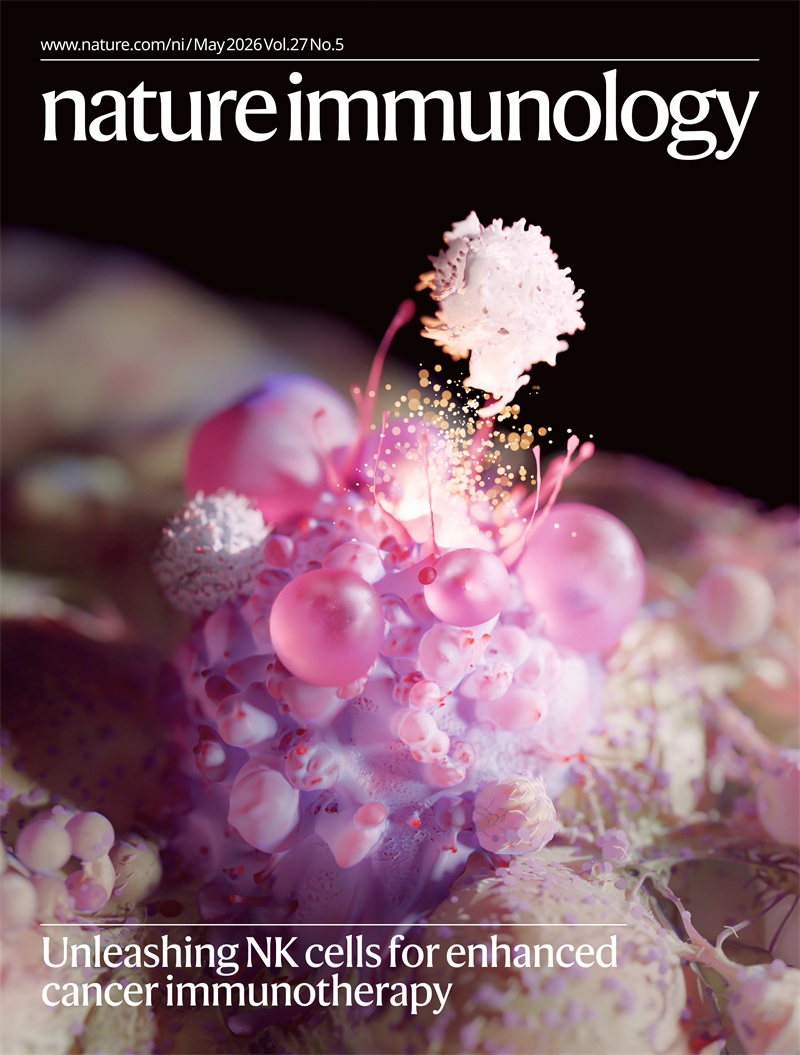
Recently, the latest research achievement from the team of Professor Cheng Sun at the Division of Life Sciences and Medicine, University of Science and Technology of China (USTC), and the State Key Laboratory of Immunity and Immunotherapy, titled “Targeting NK cell CLEC12B enhances cancer immunotherapy,” was selected as the cover article of the May 2026 issue of Nature Immunology, a leading international journal in immunology. The study systematically identified CLEC12B as a novel immune checkpoint on natural killer (NK) cells, elucidated its molecular mechanism in regulating immune evasion within the tumor microenvironment (TME), and pioneered the development of a clinically translatable targeting nanobody.
Natural killer cells are central effector cells of innate immunity. However, within the complex microenvironment of solid tumors, their cytotoxic potential is readily suppressed, leading to functional exhaustion, which has become a major bottleneck in current cancer immunotherapy. To address this challenge, the research team integrated multicenter clinical cohorts and single-cell RNA sequencing analyses and discovered that CLEC12B is significantly upregulated in tumor-infiltrating NK cells across multiple solid tumors, including hepatocellular carcinoma, colorectal cancer, and melanoma. Moreover, elevated CLEC12B expression was independently associated with poor patient prognosis, suggesting that CLEC12B serves as a critical “switch” controlling NK-cell exhaustion.
Further mechanistic investigations revealed that lipoprotein lipase (LPL) functions as a ligand for CLEC12B. Upon binding of tumor-cell-anchored LPL to CLEC12B on NK cells, intracellular inhibitory motif signaling is activated, leading to recruitment of the phosphatase SHP-1 and broad suppression of the SYK/PI3K/AKT/S6 signaling pathways. This ultimately impairs NK-cell secretion of cytotoxic mediators such as perforin and granzymes, thereby promoting tumor immune evasion.
Based on this breakthrough mechanistic discovery, the team successfully developed a high-affinity anti-CLEC12B single-domain antibody (H6-Fc nanobody). This antibody efficiently blocks the interaction between CLEC12B and LPL and robustly reverses NK-cell exhaustion. In multiple preclinical solid tumor models, the nanobody demonstrated significant antitumor efficacy as a monotherapy and exhibited strong synergistic effects when combined with PD-1 inhibitors, achieving dual activation of innate and adaptive immunity. Importantly, the antibody also showed favorable tissue tolerability and minimal hepatotoxicity.
The selection of this study as the cover article of Nature Immunology highlights the strong recognition of this work by the international scientific community. The findings further advance the understanding of NK-cell immune regulation within the tumor microenvironment and provide a clear therapeutic target and translational rationale for the development of next-generation NK-cell-targeted immunotherapies.
Peng Sun and Xiaoyu Xu from USTC contributed equally as co-first authors, and Professor Cheng Sun served as the sole corresponding author. This work represents another major achievement by Professor Cheng Sun’s team in the field of tumor immunology in recent years. The laboratory has long focused on the regulatory mechanisms of NK-cell function, systematically identifying multiple original inhibitory receptors on NK cells while advancing spatial immunomics and clinical translation. In 2025, the team’s TIMES spatial immune scoring system was recognized among China’s Top Ten Scientific Advances and Top Ten Medical Science and Technology Highlights. The related work was also published as a cover article in Nature, underscoring the laboratory’s sustained leadership and innovation in this field.
Article link: https://www.nature.com/articles/s41590-026-02471-0
Natural killer cells are central effector cells of innate immunity. However, within the complex microenvironment of solid tumors, their cytotoxic potential is readily suppressed, leading to functional exhaustion, which has become a major bottleneck in current cancer immunotherapy. To address this challenge, the research team integrated multicenter clinical cohorts and single-cell RNA sequencing analyses and discovered that CLEC12B is significantly upregulated in tumor-infiltrating NK cells across multiple solid tumors, including hepatocellular carcinoma, colorectal cancer, and melanoma. Moreover, elevated CLEC12B expression was independently associated with poor patient prognosis, suggesting that CLEC12B serves as a critical “switch” controlling NK-cell exhaustion.
Further mechanistic investigations revealed that lipoprotein lipase (LPL) functions as a ligand for CLEC12B. Upon binding of tumor-cell-anchored LPL to CLEC12B on NK cells, intracellular inhibitory motif signaling is activated, leading to recruitment of the phosphatase SHP-1 and broad suppression of the SYK/PI3K/AKT/S6 signaling pathways. This ultimately impairs NK-cell secretion of cytotoxic mediators such as perforin and granzymes, thereby promoting tumor immune evasion.
Based on this breakthrough mechanistic discovery, the team successfully developed a high-affinity anti-CLEC12B single-domain antibody (H6-Fc nanobody). This antibody efficiently blocks the interaction between CLEC12B and LPL and robustly reverses NK-cell exhaustion. In multiple preclinical solid tumor models, the nanobody demonstrated significant antitumor efficacy as a monotherapy and exhibited strong synergistic effects when combined with PD-1 inhibitors, achieving dual activation of innate and adaptive immunity. Importantly, the antibody also showed favorable tissue tolerability and minimal hepatotoxicity.
The selection of this study as the cover article of Nature Immunology highlights the strong recognition of this work by the international scientific community. The findings further advance the understanding of NK-cell immune regulation within the tumor microenvironment and provide a clear therapeutic target and translational rationale for the development of next-generation NK-cell-targeted immunotherapies.
Peng Sun and Xiaoyu Xu from USTC contributed equally as co-first authors, and Professor Cheng Sun served as the sole corresponding author. This work represents another major achievement by Professor Cheng Sun’s team in the field of tumor immunology in recent years. The laboratory has long focused on the regulatory mechanisms of NK-cell function, systematically identifying multiple original inhibitory receptors on NK cells while advancing spatial immunomics and clinical translation. In 2025, the team’s TIMES spatial immune scoring system was recognized among China’s Top Ten Scientific Advances and Top Ten Medical Science and Technology Highlights. The related work was also published as a cover article in Nature, underscoring the laboratory’s sustained leadership and innovation in this field.
Article link: https://www.nature.com/articles/s41590-026-02471-0
