


Zeng Musheng/Sun Cong’s Team Discovers a Broadly Neutralizing Antibody against Gammaherpesviruses and Reveals Its Conserved Target Epitope
Source:Sun Cong
2026-05-26
On May 7, 2026, a research team led by Academician Zeng Musheng and Dr. Sun Cong from Sun Yat-sen University Cancer Center, in collaboration with a team led by Professor Liu Zheng from Southern University of Science and Technology, published a research paper titled "A broadly protective antibody targeting gammaherpesvirus gB" in the journal Nature. This study successfully screened the first monoclonal antibody, Fab5, capable of cross-genus broad-spectrum neutralization of gammaherpesviruses. Through high-resolution structural analysis, it revealed a functionally conserved neutralizing epitope on the key viral fusion protein gB, providing a crucial theoretical foundation and novel targets for developing broad-spectrum vaccines and antibody drugs against multiple oncogenic herpesviruses.
Gammaherpesvirus is a significant subfamily of the herpesvirus family, capable of infecting various mammals, including humans, and causing severe diseases. Among them, Epstein-Barr virus (EBV) and Kaposi's sarcoma-associated herpesvirus (KSHV) are two well-known human oncogenic viruses, closely associated with various malignancies and autoimmune diseases. Co-infection with both viruses can lead to more severe tumors such as primary effusion lymphoma (PEL). Infections by gammaherpesviruses from other mammals, such as those from sheep and cattle, cause malignant hyperthermia and infertility in these animals. However, developing broad-spectrum prevention and treatment strategies, especially those offering cross-genus and cross-species protection, has remained a significant challenge in this field.
The membrane fusion process essential for herpesvirus entry into host cells relies on the highly conserved glycoprotein B (gB) on the viral surface. Therefore, gB is considered an ideal target for developing broad-spectrum intervention strategies. However, previous research has largely been confined to human viruses, with insufficient understanding of gB from animal viruses. The lack of effective antibodies capable of cross-reacting with and neutralizing viruses from different genera has prevented the identification of key conserved neutralizing sites.
To address this bottleneck, the research team built upon their previously developed EBV chimeric nanoparticle vaccine (Adv Mater, 2025). By immunizing mice and employing antigen-specific single B cell sorting technology, they successfully screened a monoclonal antibody targeting gB, named Fab5. The study found that Fab5 efficiently binds to gB proteins from various gammaherpesviruses, including EBV, KSHV, rhesus lymphocryptovirus (rhLCV), and murine gammaherpesvirus 68 (MHV68), whereas previously reported antibodies (e.g., 3A3, 3A5) exhibited strict genus specificity. Functional assays confirmed that Fab5 can broadly inhibit the cell membrane fusion process mediated by these different viral gB proteins and effectively neutralize live virus infection of various cell types, outperforming reported EBV gB antibodies.
The research team validated the in vivo protective efficacy of Fab5 in multiple animal models. In a humanized mouse model co-infected with EBV and KSHV, passive immunization with Fab5 significantly improved mouse survival rates, reduced viral loads in organs, and inhibited virus-associated pathological hyperplasia. In immunocompetent mice infected with MHV68, Fab5 also effectively reduced viral load and the number of latently infected cells. Particularly importantly, in cynomolgus macaque models susceptible to rhLCV, prophylactic administration of Fab5 almost completely blocked viremia and salivary viral shedding, with a good safety profile.
To elucidate the molecular mechanism underlying Fab5's broad-spectrum protection, the researchers further resolved the cryo-electron microscopy structures of Fab5 in complex with gB proteins from multiple gammaherpesviruses. The structures revealed that Fab5 binds to Domain I (DI) of the gB protein, a region with a highly conserved conformation across gammaherpesviruses. In the complexes of EBV, rhLCV, and MHV68 gB with Fab5, Fab5 binds symmetrically to the gB trimer through a set of conserved hydrogen bonds and amino acid side-chain interactions. Further sequence and structural mapping indicated that the DI epitope recognized by Fab5 exhibits the characteristic of being functionally conserved but partially variable in sequence across gammaherpesvirus genera. This domain maintains high structural stability and surface accessibility in both the pre-fusion and post-fusion conformations of gB, constituting its conserved neutralizing epitope.
It is worth noting that the Zeng Musheng/Sun Cong team, in two consecutive papers published in Nature and Nature Microbiology in 2025, revealed the common receptor R9AP and the major receptor DSC2 for EBV entry into B cells and epithelial cells, respectively, and elucidated the pathway where gH/gL, after recognizing the receptor, activates gB to trigger membrane fusion. Based on these prior systematic discoveries, this study further proposes that the mechanism of action of Fab5 likely involves blocking the necessary conformational changes of gB during membrane fusion or interfering with the fusion-activation signal transmission from gH/gL to gB by binding to the conserved DI epitope on gB, thereby achieving broad-spectrum interception of multiple gammaherpesviruses.
In summary, this study not only provides the first prototype of a gammaherpesvirus neutralizing antibody with cross-genus protective potential but also atomically resolves the functionally critical conserved "Achilles' heel" on gB. This lays a solid foundation for the future design of optimized immunogens capable of inducing similar broad-spectrum antibody responses and for developing a new generation of broad-spectrum herpesvirus vaccines and drugs.
Academician Zeng Musheng and Associate Researcher Sun Cong from Sun Yat-sen University Cancer Center, and Professor Liu Zheng from Southern University of Science and Technology are the co-corresponding authors of this paper. Associate Researcher Sun Cong, Postdoctoral Fellow Xie Chu from Sun Yat-sen University Cancer Center, and Master's student Cheng Bingzhen from Southern University of Science and Technology are the co-first authors. This research was supported by the National Natural Science Foundation of China, National Major Science and Technology Projects, and other funds.
Article link: https://www.nature.com/articles/s41586-026-10192-5
Gammaherpesvirus is a significant subfamily of the herpesvirus family, capable of infecting various mammals, including humans, and causing severe diseases. Among them, Epstein-Barr virus (EBV) and Kaposi's sarcoma-associated herpesvirus (KSHV) are two well-known human oncogenic viruses, closely associated with various malignancies and autoimmune diseases. Co-infection with both viruses can lead to more severe tumors such as primary effusion lymphoma (PEL). Infections by gammaherpesviruses from other mammals, such as those from sheep and cattle, cause malignant hyperthermia and infertility in these animals. However, developing broad-spectrum prevention and treatment strategies, especially those offering cross-genus and cross-species protection, has remained a significant challenge in this field.
The membrane fusion process essential for herpesvirus entry into host cells relies on the highly conserved glycoprotein B (gB) on the viral surface. Therefore, gB is considered an ideal target for developing broad-spectrum intervention strategies. However, previous research has largely been confined to human viruses, with insufficient understanding of gB from animal viruses. The lack of effective antibodies capable of cross-reacting with and neutralizing viruses from different genera has prevented the identification of key conserved neutralizing sites.
To address this bottleneck, the research team built upon their previously developed EBV chimeric nanoparticle vaccine (Adv Mater, 2025). By immunizing mice and employing antigen-specific single B cell sorting technology, they successfully screened a monoclonal antibody targeting gB, named Fab5. The study found that Fab5 efficiently binds to gB proteins from various gammaherpesviruses, including EBV, KSHV, rhesus lymphocryptovirus (rhLCV), and murine gammaherpesvirus 68 (MHV68), whereas previously reported antibodies (e.g., 3A3, 3A5) exhibited strict genus specificity. Functional assays confirmed that Fab5 can broadly inhibit the cell membrane fusion process mediated by these different viral gB proteins and effectively neutralize live virus infection of various cell types, outperforming reported EBV gB antibodies.
The research team validated the in vivo protective efficacy of Fab5 in multiple animal models. In a humanized mouse model co-infected with EBV and KSHV, passive immunization with Fab5 significantly improved mouse survival rates, reduced viral loads in organs, and inhibited virus-associated pathological hyperplasia. In immunocompetent mice infected with MHV68, Fab5 also effectively reduced viral load and the number of latently infected cells. Particularly importantly, in cynomolgus macaque models susceptible to rhLCV, prophylactic administration of Fab5 almost completely blocked viremia and salivary viral shedding, with a good safety profile.
To elucidate the molecular mechanism underlying Fab5's broad-spectrum protection, the researchers further resolved the cryo-electron microscopy structures of Fab5 in complex with gB proteins from multiple gammaherpesviruses. The structures revealed that Fab5 binds to Domain I (DI) of the gB protein, a region with a highly conserved conformation across gammaherpesviruses. In the complexes of EBV, rhLCV, and MHV68 gB with Fab5, Fab5 binds symmetrically to the gB trimer through a set of conserved hydrogen bonds and amino acid side-chain interactions. Further sequence and structural mapping indicated that the DI epitope recognized by Fab5 exhibits the characteristic of being functionally conserved but partially variable in sequence across gammaherpesvirus genera. This domain maintains high structural stability and surface accessibility in both the pre-fusion and post-fusion conformations of gB, constituting its conserved neutralizing epitope.
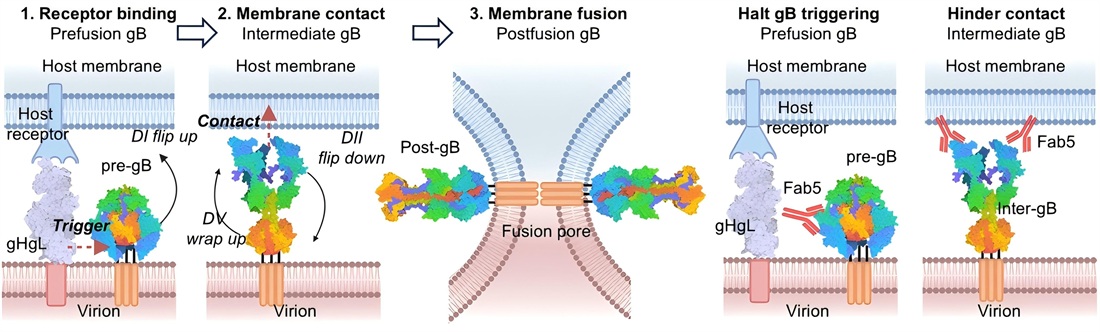
It is worth noting that the Zeng Musheng/Sun Cong team, in two consecutive papers published in Nature and Nature Microbiology in 2025, revealed the common receptor R9AP and the major receptor DSC2 for EBV entry into B cells and epithelial cells, respectively, and elucidated the pathway where gH/gL, after recognizing the receptor, activates gB to trigger membrane fusion. Based on these prior systematic discoveries, this study further proposes that the mechanism of action of Fab5 likely involves blocking the necessary conformational changes of gB during membrane fusion or interfering with the fusion-activation signal transmission from gH/gL to gB by binding to the conserved DI epitope on gB, thereby achieving broad-spectrum interception of multiple gammaherpesviruses.
Fig. Mechanism of membrane fusion mediated by gammaherpesvirus gB and the potential neutralization mechanism of Fab5
In summary, this study not only provides the first prototype of a gammaherpesvirus neutralizing antibody with cross-genus protective potential but also atomically resolves the functionally critical conserved "Achilles' heel" on gB. This lays a solid foundation for the future design of optimized immunogens capable of inducing similar broad-spectrum antibody responses and for developing a new generation of broad-spectrum herpesvirus vaccines and drugs.
Academician Zeng Musheng and Associate Researcher Sun Cong from Sun Yat-sen University Cancer Center, and Professor Liu Zheng from Southern University of Science and Technology are the co-corresponding authors of this paper. Associate Researcher Sun Cong, Postdoctoral Fellow Xie Chu from Sun Yat-sen University Cancer Center, and Master's student Cheng Bingzhen from Southern University of Science and Technology are the co-first authors. This research was supported by the National Natural Science Foundation of China, National Major Science and Technology Projects, and other funds.
Article link: https://www.nature.com/articles/s41586-026-10192-5
