


QIAN Youcun’s Team Reveals a Novel Natural “Decoy Receptor” that Protects against Inflammatory Bowel Disease
Source:LI Qi
2026-03-10
In January 6,2026, Prof. QIAN Youcun from the Shanghai Institute of Nutrition and Health (SINH) of the Chinese Academy of Sciences published a study in Nature Immunology, titled “The IL17REL gene encodes a decoy receptor of IL-17 family cytokines to control gut inflammation”. The research identified a new member of the human IL 17 receptor family, IL 17REL, which plays a protective role in inflammatory bowel disease (IBD), and showed that genetic variants in IL17REL critically affect IBD.
IBD is a group of chronic inflammatory disorders of the intestine, including Crohn’s disease (CD) and ulcerative colitis (UC). The incidence of IBD is steadily increasing worldwide, and it is considered a serious threat to public health. Epidemiological and genetic studies have suggested that genetic susceptibility, together with various environmental factors, provides a basis for IBD onset and progression. To determine genetic factors in IBD, numerous genetic studies based on genome wide association studies (GWAS) and exome sequencing have identified more than 240 single nucleotide polymorphism (SNP) loci associated with IBD. However, the functions of the vast majority of IBD associated loci remain unclear. In addition, whether these variants directly contribute to IBD pathology and their precise molecular mechanisms need further study.
IL17REL has been identified as an IBD associated gene and predicted to encode a protein similar to IL 17RE, but whether it is translated is unknown. In this study, researchers analyzed tissues from IBD patients. Using RNA in situ hybridization and immunohistochemistry, they confirmed that the expression of IL17REL could be induced in immune cells, including macrophages, T cells, and B cells. They also found that transforming growth factor β (TGF β) played a key role in this induction.
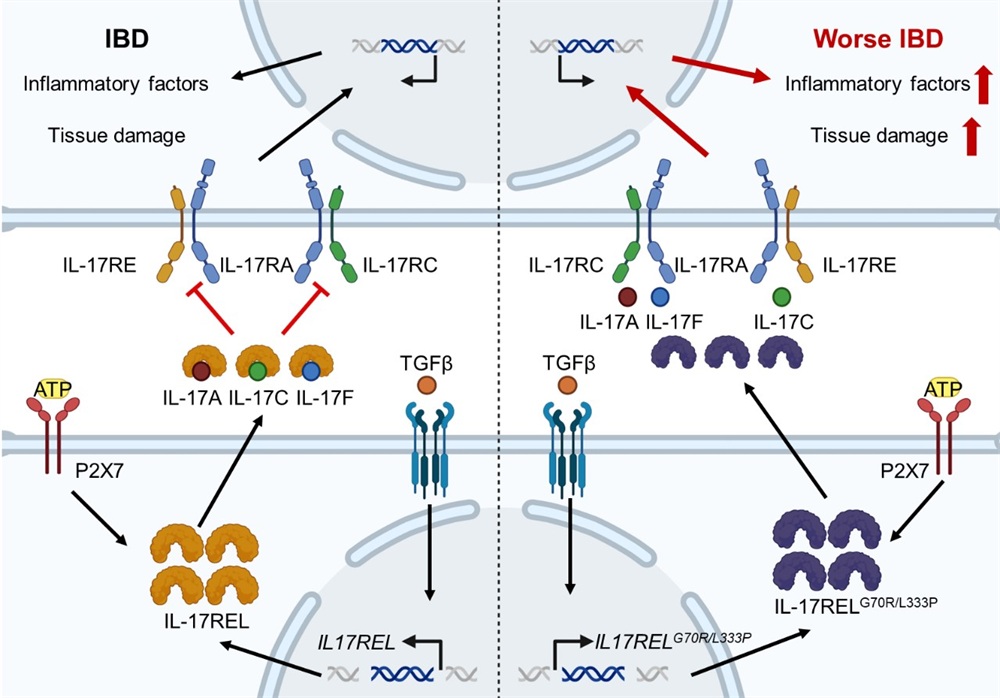
Although the IL 17REL protein lacks a canonical signal peptide, researchers found that it could be released extracellularly via an ATP–P2RX7–GSDMD pathway. Extracellular IL 17REL, as a specific endogenous “decoy receptor,” bound competitively and in a concentration dependent manner to several IL 17 ligands recognized by IL 17RA, suppressing the expression of downstream inflammatory genes. In vivo, knock in of the human IL17REL gene in mice substantially ameliorated TNBS induced colitis.
Moreover, researchers carried out experiments to validate the pathogenic mechanisms of two identified IL17REL SNPs significantly associated with IBD. They found that, in vitro, mutant IL 17REL proteins largely lost their ability to bind IL 17A, IL 17C, and IL 17F and lost antagonistic activity against IL-17 signaling. They also found that, in vivo, mice carrying the mutant IL17REL knock in completely lost the protective effect of wild type IL 17REL in TNBS induced colitis. Based on these findings, researchers evaluated the therapeutic potential of recombinant IL 17REL protein. They showed that the systemic administration of wild type IL 17REL markedly improved TNBS induced colitis in mice, whereas the mutant protein had no therapeutic effect.
This study is the first to identify IL 17REL as a decoy receptor within the IL 17 family. It elucidates the expression regulation and immune functions of the IL17REL gene and demonstrates that functional mutations in IL17REL are important genetic contributors to IBD. The study offers a new concept for understanding IBD pathogenesis and provides a potential target for therapies aimed at the IL-17 signaling pathway.
The team has long been engaged in studies of IL 17 family cytokines and their receptors, producing a series of related findings (Nat. Immunol. 2011; Nat. Med. 2012; Immunity 2014, 2015, 2019). This study is the first to identify and systematically characterize IL 17REL as a decoy receptor within the IL 17 family, elucidate its expression regulation and immune functions, and demonstrate that its functional mutations are important genetic contributors to IBD. These findings offer a new conceptual framework for understanding IBD pathogenesis and point to a novel potential target for therapies aimed at the IL 17 signaling pathway.
Prof. QIAN Youcun and Assoc. Prof. YANG Tao from the SINH are the co-corresponding authors of the article. Postdoc. LI Qi from SINH is the first authors of the paper. The work was supported by contributions from Prof. LiIU Zhanju (The Tenth People’s Hospital affiliated to Tongji University) and Prof. SONG Xinyang (Center for Excellence in Molecular Cell Science, CAS). This research was granted by the National Natural Science Foundation of China and the National Key R&D Program.
Article link:https://www.nature.com/articles/s41590-025-02368-4
IBD is a group of chronic inflammatory disorders of the intestine, including Crohn’s disease (CD) and ulcerative colitis (UC). The incidence of IBD is steadily increasing worldwide, and it is considered a serious threat to public health. Epidemiological and genetic studies have suggested that genetic susceptibility, together with various environmental factors, provides a basis for IBD onset and progression. To determine genetic factors in IBD, numerous genetic studies based on genome wide association studies (GWAS) and exome sequencing have identified more than 240 single nucleotide polymorphism (SNP) loci associated with IBD. However, the functions of the vast majority of IBD associated loci remain unclear. In addition, whether these variants directly contribute to IBD pathology and their precise molecular mechanisms need further study.
IL17REL has been identified as an IBD associated gene and predicted to encode a protein similar to IL 17RE, but whether it is translated is unknown. In this study, researchers analyzed tissues from IBD patients. Using RNA in situ hybridization and immunohistochemistry, they confirmed that the expression of IL17REL could be induced in immune cells, including macrophages, T cells, and B cells. They also found that transforming growth factor β (TGF β) played a key role in this induction.
Although the IL 17REL protein lacks a canonical signal peptide, researchers found that it could be released extracellularly via an ATP–P2RX7–GSDMD pathway. Extracellular IL 17REL, as a specific endogenous “decoy receptor,” bound competitively and in a concentration dependent manner to several IL 17 ligands recognized by IL 17RA, suppressing the expression of downstream inflammatory genes. In vivo, knock in of the human IL17REL gene in mice substantially ameliorated TNBS induced colitis.
Moreover, researchers carried out experiments to validate the pathogenic mechanisms of two identified IL17REL SNPs significantly associated with IBD. They found that, in vitro, mutant IL 17REL proteins largely lost their ability to bind IL 17A, IL 17C, and IL 17F and lost antagonistic activity against IL-17 signaling. They also found that, in vivo, mice carrying the mutant IL17REL knock in completely lost the protective effect of wild type IL 17REL in TNBS induced colitis. Based on these findings, researchers evaluated the therapeutic potential of recombinant IL 17REL protein. They showed that the systemic administration of wild type IL 17REL markedly improved TNBS induced colitis in mice, whereas the mutant protein had no therapeutic effect.
This study is the first to identify IL 17REL as a decoy receptor within the IL 17 family. It elucidates the expression regulation and immune functions of the IL17REL gene and demonstrates that functional mutations in IL17REL are important genetic contributors to IBD. The study offers a new concept for understanding IBD pathogenesis and provides a potential target for therapies aimed at the IL-17 signaling pathway.
The wild-type, rather than mutated IL-17REL protein exerted therapeutic effects against inflammatory bowel disease by competitively binding IL-17 family ligands and suppressing downstream gene expression (Image provided by Prof. QIAN’s group)
The team has long been engaged in studies of IL 17 family cytokines and their receptors, producing a series of related findings (Nat. Immunol. 2011; Nat. Med. 2012; Immunity 2014, 2015, 2019). This study is the first to identify and systematically characterize IL 17REL as a decoy receptor within the IL 17 family, elucidate its expression regulation and immune functions, and demonstrate that its functional mutations are important genetic contributors to IBD. These findings offer a new conceptual framework for understanding IBD pathogenesis and point to a novel potential target for therapies aimed at the IL 17 signaling pathway.
Prof. QIAN Youcun and Assoc. Prof. YANG Tao from the SINH are the co-corresponding authors of the article. Postdoc. LI Qi from SINH is the first authors of the paper. The work was supported by contributions from Prof. LiIU Zhanju (The Tenth People’s Hospital affiliated to Tongji University) and Prof. SONG Xinyang (Center for Excellence in Molecular Cell Science, CAS). This research was granted by the National Natural Science Foundation of China and the National Key R&D Program.
Article link:https://www.nature.com/articles/s41590-025-02368-4
