


New Mechanism of Rotavirus-Induced Liver Failure in Neonates Unveiled, Folic Acid Therapy Shows Clinical Breakthrough
Source:Yuxia Zhang
2026-01-15
A recent study published in Immunity by members of the Chinese Society of Immunology has elucidated a novel immunometabolic axis through which systemic rotavirus infection triggers lethal liver pathology in neonates. The research further translates this mechanism into a successful clinical intervention, offering a new therapeutic strategy for biliary atresia and other rotavirus-related neonatal diseases.
This multicenter collaborative study, led by Guangzhou Women and Children’s Medical Center of Guangzhou Medical University, builds upon the team’s earlier Cell paper that mapped the immune landscape of biliary atresia. The researchers discovered that rotavirus infection persistently activates type I interferon signaling in hepatic macrophages, upregulating hepcidin in hepatocytes and TREM2⁺ macrophages. This impairs SLC40A1-mediated iron export, leading to systemic iron overload and luminal iron deficiency. Iron accumulation not only promotes viral replication in Kupffer cells but also induces ferroptosis in intestinal and biliary epithelial cells, while activating T and B cell-mediated immune attacks, forming a vicious cycle of “virus–immunity–metabolism”.
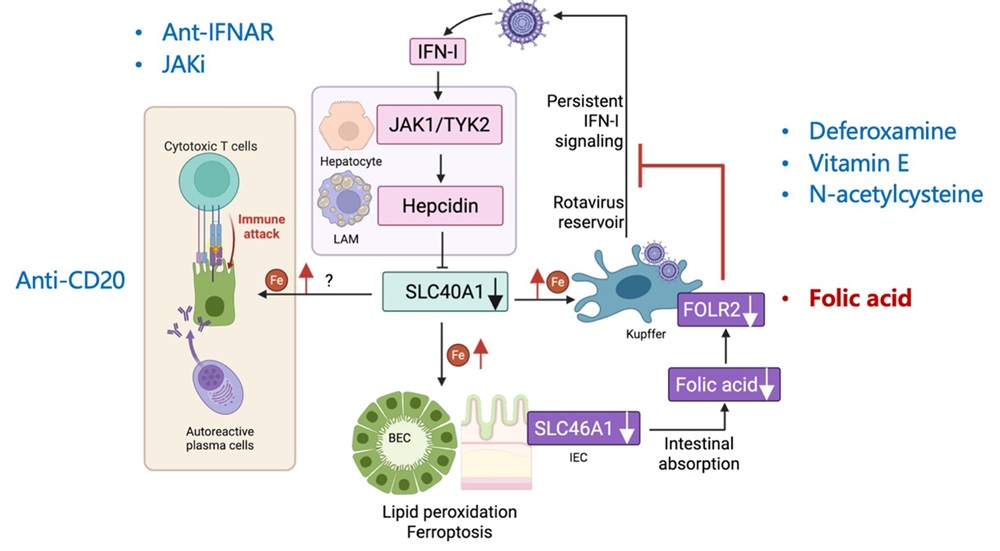
The study innovatively proposes the “immune–iron axis” as a critical link between innate and adaptive immunity. Interventions such as anti-IFNAR or JAK inhibitor administered 18 hours post-infection, or iron chelation with DFO, significantly reduced viral load and ameliorated liver injury, suggesting that antiviral strategies should integrate immunometabolic modulation.
Notably, based on this mechanism, the team conducted a randomized, double-blind, placebo-controlled clinical trial, demonstrating that postoperative folic acid supplementation significantly reduced the incidence of cholangitis and delayed the need for liver transplantation in infants, with a favorable safety profile. This represents the first successful application of nutritional metabolic intervention in structural liver disease, holding substantial public health implications.
This research not only provides new insights into the pathogenesis and treatment of neonatal infection-related liver diseases but also promotes the integration of immunology with metabolism and clinical medicine, positioning China at the forefront of pediatric immunometabolic research globally.
Article link: https://www.cell.com/immunity/fulltext/S1074-7613(25)00503-5
Introduction of the Research Center Team
The Clinical Research Center for Pediatric Infection and Immunity, based at Guangzhou Women and Children's Medical Center affiliated with Guangzhou Medical University, focuses on investigating the immunopathological mechanisms and translational research of major infectious and immune-related diseases in children. The team is co-led by Dr. Yuxia Zhang (Principal Investigator) and Dr. Zhanghua Chen, who have extensive expertise in pediatric immunometabolism, gut-liver axis immunity, respiratory mucosal immunity, and systemic inflammatory disorders. They have published a series of influential studies in top-tier international journals such as Cell, Nature Immunology, and Immunity, and are actively engaged in translating fundamental discoveries into clinical applications.
The center is equipped with advanced research platforms, interdisciplinary collaboration systems, and extensive clinical resources, all dedicated to cultivating young scientific talents with international perspectives and innovative capabilities. The team encourages outstanding students with a strong interest in infection and immunology, pediatric disease mechanisms, immunometabolism, and bioinformatics to apply for their doctoral programs. They also welcome postdoctoral researchers who have recently completed their PhD to join the team. Together, they aim to explore new frontiers in pediatric immunology and advance child health research.
This multicenter collaborative study, led by Guangzhou Women and Children’s Medical Center of Guangzhou Medical University, builds upon the team’s earlier Cell paper that mapped the immune landscape of biliary atresia. The researchers discovered that rotavirus infection persistently activates type I interferon signaling in hepatic macrophages, upregulating hepcidin in hepatocytes and TREM2⁺ macrophages. This impairs SLC40A1-mediated iron export, leading to systemic iron overload and luminal iron deficiency. Iron accumulation not only promotes viral replication in Kupffer cells but also induces ferroptosis in intestinal and biliary epithelial cells, while activating T and B cell-mediated immune attacks, forming a vicious cycle of “virus–immunity–metabolism”.
The study innovatively proposes the “immune–iron axis” as a critical link between innate and adaptive immunity. Interventions such as anti-IFNAR or JAK inhibitor administered 18 hours post-infection, or iron chelation with DFO, significantly reduced viral load and ameliorated liver injury, suggesting that antiviral strategies should integrate immunometabolic modulation.
Notably, based on this mechanism, the team conducted a randomized, double-blind, placebo-controlled clinical trial, demonstrating that postoperative folic acid supplementation significantly reduced the incidence of cholangitis and delayed the need for liver transplantation in infants, with a favorable safety profile. This represents the first successful application of nutritional metabolic intervention in structural liver disease, holding substantial public health implications.
This research not only provides new insights into the pathogenesis and treatment of neonatal infection-related liver diseases but also promotes the integration of immunology with metabolism and clinical medicine, positioning China at the forefront of pediatric immunometabolic research globally.
Article link: https://www.cell.com/immunity/fulltext/S1074-7613(25)00503-5
Introduction of the Research Center Team
The Clinical Research Center for Pediatric Infection and Immunity, based at Guangzhou Women and Children's Medical Center affiliated with Guangzhou Medical University, focuses on investigating the immunopathological mechanisms and translational research of major infectious and immune-related diseases in children. The team is co-led by Dr. Yuxia Zhang (Principal Investigator) and Dr. Zhanghua Chen, who have extensive expertise in pediatric immunometabolism, gut-liver axis immunity, respiratory mucosal immunity, and systemic inflammatory disorders. They have published a series of influential studies in top-tier international journals such as Cell, Nature Immunology, and Immunity, and are actively engaged in translating fundamental discoveries into clinical applications.
The center is equipped with advanced research platforms, interdisciplinary collaboration systems, and extensive clinical resources, all dedicated to cultivating young scientific talents with international perspectives and innovative capabilities. The team encourages outstanding students with a strong interest in infection and immunology, pediatric disease mechanisms, immunometabolism, and bioinformatics to apply for their doctoral programs. They also welcome postdoctoral researchers who have recently completed their PhD to join the team. Together, they aim to explore new frontiers in pediatric immunology and advance child health research.
